Introduction to Research: First Steps for Doctors
Beginner friendly Never done research? Start here — research is desirable on most person specifications
Never been involved in research? Start here. Research appears on almost every NHS person specification — this course takes you from zero to your first real step.
- Research explained in plain English — no statistics background needed
- Realistic first steps: GCP training, helping with NHS studies, posters and case reports
- An honest, confident answer for 'Tell us about your research experience' — even if you have none yet
- Format
- 6 short modules · about 10 min each · stop and come back any time
- Slides
- 19
- Quiz
- 15 questions
- Pass mark
- 12/15
- Studying
- Free
- Certificate
- £5 after you pass
or save up to 60% with a bundle - Last reviewed
- October 2026 · how we check our courses
No sign-up needed for this course, and your progress is saved on this device. When you pass, get your certificate for £5 — evidence for your CV, appraisal and interviews.

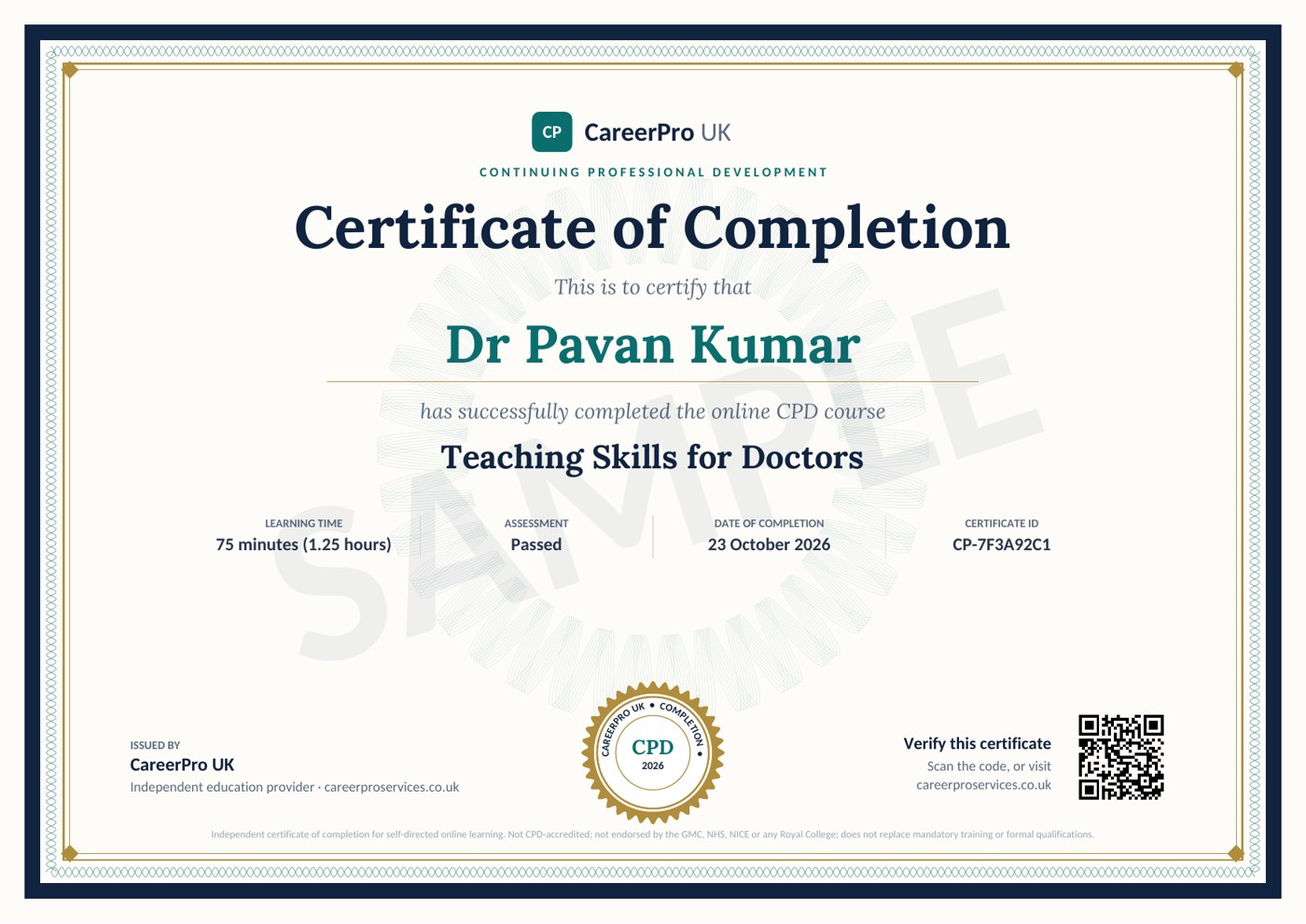
Finish with evidence you can show
Complete the course and pass the short quiz to earn a certificate of completion you can show to shortlisters, appraisers and interview panels.
- A verifiable certificate with a QR code — for your CV, portfolio and appraisal
- An appraisal-ready reflective note, pre-filled with the learning outcomes
- A ready-made CV line and a supporting-statement paragraph for NHS Jobs and Trac
- Add it to your LinkedIn profile in one click
- Pay £5 only at the end, and only if you pass — or save with a bundle
Never been involved in research? Start here. This beginner's course explains research in plain English — no statistics background needed. You will learn what research is (and how it differs from audit), the main types of study, the research journey step by step, the key words you'll hear, how to read an abstract, ethics and consent, and — most importantly — realistic first steps to get involved as a doctor in the UK: helping with NHS studies, Good Clinical Practice training, case reports and posters. You finish with your own first-step plan and an honest way to talk about research at interview, even if you have none yet.
What you'll learn
- Explain in plain English what research is, and how it differs from audit and service evaluation
- Describe the main types of study and what each is good for
- Follow the research journey from idea to publication
- Understand the key words used in research
- Read an abstract and pick out the main points
- Explain why research needs ethics approval and informed consent
- Find realistic ways to get involved, even as a complete beginner
- Describe your research understanding honestly on your CV and at interview
Course outline
1What research is — and why it matters to you
- Welcome — research is for every doctor — Many doctors think research is only for professors in laboratories. It isn't.
- What is research? — Research is a careful, planned way of answering a question to find out something new that can be useful beyond your own hospital.
- Why research matters for you — Research matters for patients, who do better in hospitals that are active in research.
2The main types of study
- The main types of study — in plain English — Studies come in a handful of main types. Each is good at answering a certain kind of question. The simplest way to sort them is to ask: did the researchers decide who got the treatment, or did they just watch what happened?
- Match the study to the question — Try these. For each one, ask yourself: is the question about whether a treatment works, about how common or how likely something is, about people's experiences, or about a single unusual case?
3The research journey, step by step
- The research journey — Every research project, large or small, follows roughly the same path.
- Step 1 — turning an idea into a question — Most research starts with curiosity on the ward: 'Why do so many of our patients get readmitted?' or 'Would this work better?' That curiosity is valuable, but it is too vague to study.
- Ethics, approvals and consent — Research involves people who trust us. Ethics rules protect them.
- Key words you will hear — Research has its own vocabulary, and it can make meetings feel confusing at first. You don't need to learn these by heart — come back to this list whenever you hear a word you don't know.
4Reading a research paper for the first time
- Reading an abstract without fear — Many doctors avoid reading research papers because they look long and technical. The good news is that you rarely need to start with the whole paper.
- Simple numbers you'll see — Results sections are full of numbers, but a few simple ideas cover most of what you need to start with. The aim here is not to calculate anything, but to recognise what each number is telling you.
5Getting involved: realistic first steps
- Realistic first steps — you can start this month — You do not need an idea of your own, funding or a supervisor in place to begin. The quickest way into research in the NHS is to help with studies that are already running.
- Helping with a study: what you will actually do — If you join a study team as a beginner, your role will usually be clearly defined and supervised. Research nurses and practitioners are often the backbone of the team, and you will learn a lot from them.
- Your first poster or case report — Posters and case reports are the most common first outputs for doctors, because they are small, achievable projects you can finish alongside clinical work.
- Build your first-step plan — Fill this in now — it's saved on this device and you can download it at the end. Small steps count.
6Talking about research on your CV and at interview
- Research on your CV — honestly — Shortlisters read many CVs, and they are good at spotting vague or inflated claims. Honest, specific entries are more convincing — and anything you write may be checked or discussed at interview.
- Download your plan — Share your plan with your educational or clinical supervisor at your next meeting. Supervisors can often suggest a study, a project or a colleague to contact, and having your plan written down makes that conversation much easier.
- Using this course in your NHS application — Shortlisting for NHS posts is usually done by scoring your application against each criterion in the person specification, which are listed as essential or desirable.
- Summary
Frequently asked questions
Is the Research for Beginners course free?
Yes. The Research for Beginners course is free to study online, with no sign-up. Studying is free. If you want a certificate of completion, it costs £5, and you pay only after you pass the quiz.
Who is this course for?
Beginner — no research experience needed. It is written for NHS doctors and international medical graduates (IMGs).
What will I learn?
You will be able to: explain in plain English what research is, and how it differs from audit and service evaluation; describe the main types of study and what each is good for; follow the research journey from idea to publication; understand the key words used in research; read an abstract and pick out the main points; explain why research needs ethics approval and informed consent; find realistic ways to get involved, even as a complete beginner; describe your research understanding honestly on your CV and at interview.
How long does it take?
The course has 6 short modules of about 10 minutes each, and your progress is saved so you can stop and come back. Your certificate records your learning time for your appraisal portfolio.
Is the course accredited?
Online course — not Good Clinical Practice (GCP) certification. The certificate confirms completion of self-directed learning, which you can record in your appraisal portfolio with your own reflection.
Can I use it in my NHS job application?
Yes. List it under 'Research and publications' on your CV and in the education or training section of your NHS Jobs or Trac application, and use what you learned as evidence in your supporting statement. The certificate has a QR code so shortlisters can verify it.
✍️ Writing your NHS supporting statement? See an example paragraph for this criterion and examples for every other common person specification point.
Independent study guide by CareerPro UK, reviewed October 2026. About this course
This is an independent beginner's guide to medical research, written in our own words from publicly available sources. It is not Good Clinical Practice (GCP) certification and does not give you approval to do research — research in the NHS must follow your organisation's research and development (R&D) processes and Health Research Authority requirements.
CareerPro UK is an independent education provider. Our courses are not produced, endorsed, approved or accredited by the General Medical Council (GMC), the NHS, NICE, any Royal College or any other official body, and we are not affiliated with them. Courses are study guides written in our own words from publicly available guidance. They do not replace the official guidance, which can change — always check the current version (e.g. at gmc-uk.org and nice.org.uk). They are not legal or professional advice: for a specific situation, follow your employer's policies and speak to your seniors or your medical defence organisation.
Quiz
Answer all 15 questions. You need 12 correct to pass. You can retake it.
Get your certificate
Your certificate is ready
- Your verifiable PDF certificate with a QR code, so shortlisters and appraisers can check it's genuine
- A ready-to-paste line for your NHS Jobs or Trac application and your CV
- An appraisal-ready reflective note, pre-filled with the course's learning outcomes and your CPD time
- One-click add to your LinkedIn profile
The course itself is free. The certificate pack is a one-off £5, with no subscription. Payment is handled securely by Stripe, and we never see your card details.
Have a bundle code?
Taking several courses? Save with a certificate bundle — from £27 for 6 certificates.
Well done — you've passed
Keep the PDF — its QR code lets an appraiser or employer confirm it's genuine.
Independent certificate of completion; not CPD-accredited or endorsed by the GMC, NHS or any Royal College.
Write a quick reflection for your portfolio
Appraisers value reflection more than certificates. Jot down a few lines while it's fresh — it stays on this device until you copy it.
Free sign-up to start this course
Sign up once with your email and you can study every course free. Your certificate is optional and paid only after you pass.
We use your details to give you access to the courses. See our privacy notice.
Get new courses and NHS job alerts
Optional — leave your email if you'd like us to tell you about new CPD courses, NHS job alerts and career support. You can unsubscribe at any time.
See our privacy notice.