Research and Critical Appraisal: Evidence-Based Medicine for Doctors
Specialty training Critical appraisal is scored in specialty training applications and interviews
'Understanding of research' and 'ability to critically appraise evidence' are on almost every NHS person specification. Build the skills — and the evidence — that get you shortlisted.
- Statistics in plain English, with worked examples: confidence intervals, NNT, sensitivity and specificity
- Appraise a trial step by step and present it at journal club — then download your appraisal
- Realistic routes into research and publication, plus the UK's new 2026 clinical trial rules
- Format
- 6 short modules · about 15 min each · stop and come back any time
- Slides
- 26
- Quiz
- 15 questions
- Pass mark
- 12/15
- Studying
- Free
- Certificate
- £9 after you pass
or save up to 60% with a bundle - Last reviewed
- October 2026 · how we check our courses
Free sign-up with your email unlocks this course and every other course, and your progress is saved on this device. When you pass, get your certificate for £9 — evidence for your CV, appraisal and interviews.

Finish with evidence you can show
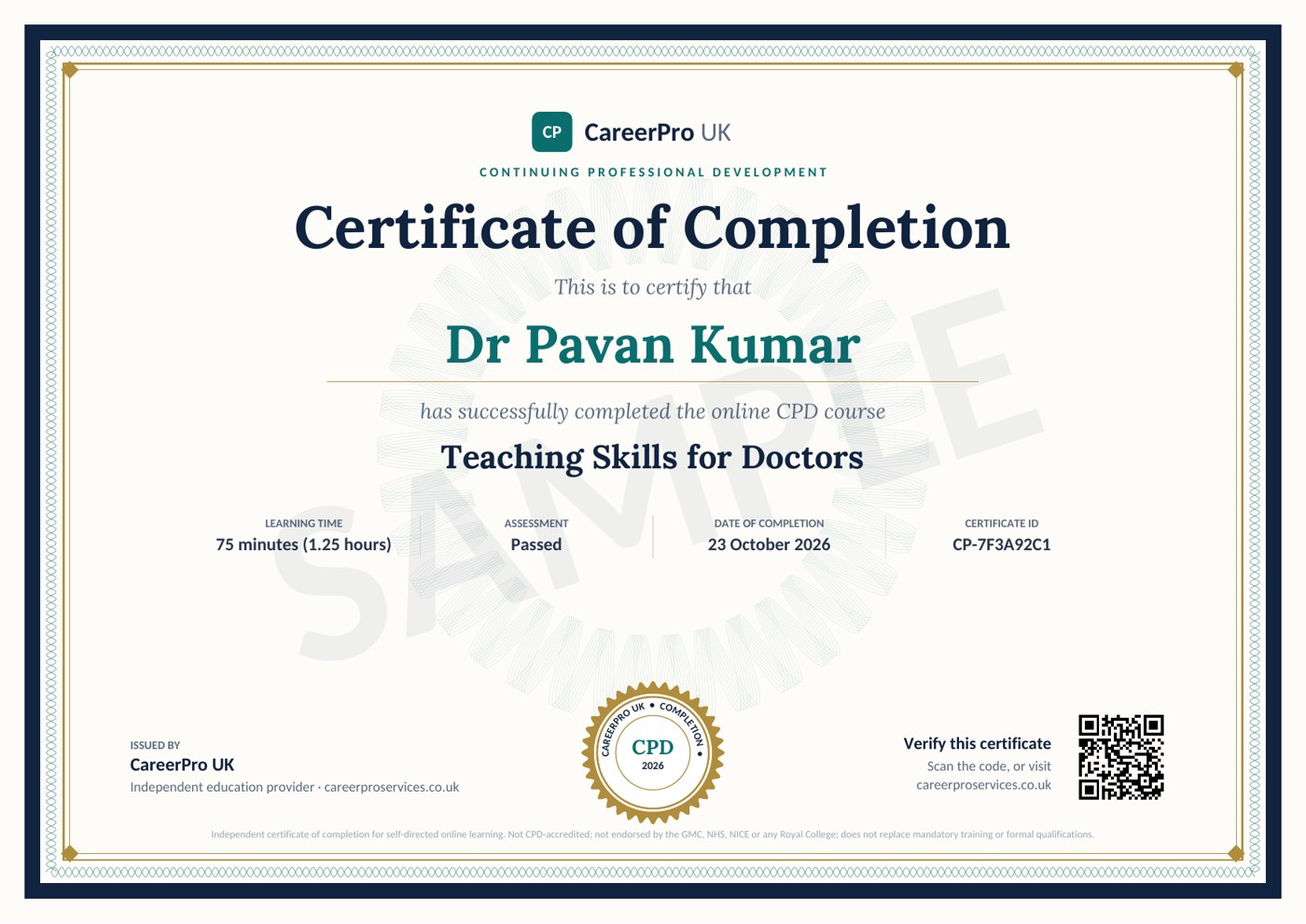
Complete the course and pass the short quiz to earn a certificate of completion you can show to shortlisters, appraisers and interview panels.
- A verifiable certificate with a QR code — for your CV, portfolio and appraisal
- An appraisal-ready reflective note, pre-filled with the learning outcomes
- A ready-made CV line and a supporting-statement paragraph for NHS Jobs and Trac
- Add it to your LinkedIn profile in one click
- Pay £9 only at the end, and only if you pass — or save with a bundle
'Understanding of research' and 'ability to critically appraise evidence' appear on almost every NHS person specification, and research experience is often what separates shortlisted candidates. This practical course takes you from asking a clear clinical question to finding, appraising and applying evidence: study designs, bias, statistics in plain English (with worked NNT and diagnostic-test calculations), appraising a trial step by step, presenting at journal club, research ethics and approvals, Good Clinical Practice and the UK's new clinical trial rules (April 2026), and realistic ways to get involved in research and your first publication. You build a paper-appraisal summary you can download.
What you'll learn
- Explain evidence-based medicine and turn a clinical problem into a focused PICO question
- Search effectively for evidence using the right sources
- Choose the right study design for a question and recognise common biases
- Interpret p-values, confidence intervals, relative and absolute risk, NNT, sensitivity, specificity and predictive values
- Critically appraise a randomised controlled trial using a structured checklist
- Present a paper at journal club and apply evidence to individual patients
- Explain research ethics, HRA approval, Good Clinical Practice and the UK's 2026 clinical trial rules
- Find realistic ways to get involved in research and publish, and describe it on your CV
Course outline
1Evidence-based medicine: the basics
- Welcome — why research matters for your career — You do not need a PhD to show research skills.
- Why evidence matters in everyday NHS practice — Every day, doctors make decisions that rest on evidence: which antibiotic, whether to anticoagulate, how long to continue an antidepressant, whether a scan is needed.
- What is evidence-based medicine? — Evidence-based medicine (EBM), as described by David Sackett and colleagues, is the conscientious, explicit and judicious use of the current best evidence in making decisions about the care of individual patients — integrating it with clinical expertise and the patient's values and preferences.
- Asking a focused question — PICO — The quality of the answer depends on the quality of the question. 'Are statins good?' cannot be answered, because it does not say for whom, compared with what, or good for what.
- Research, audit or service evaluation? — These three activities are often confused, but the difference matters because it decides what approvals you need.
2Finding the evidence
- Where to find evidence — There is far too much published research for anyone to read. The skill is knowing where to look first.
- Searching well — Start by turning your PICO into search terms, including synonyms (e.g. 'heart attack' OR 'myocardial infarction'). Combine concepts with AND and synonyms with OR, and exclude with NOT, carefully.
3Study designs and bias
- Study designs — the hierarchy of evidence — Different study designs give different strengths of evidence. The 'hierarchy of evidence' ranks them roughly by how well they protect against bias when answering questions about treatment.
- Choose the right design — Before you judge how well a study was done, ask whether it was the right kind of study for its question. Different types of clinical question are best answered by different designs.
- Bias and confounding — Bias is a systematic error: something in the way a study is designed, run or reported that pushes the result away from the truth in a particular direction. It is different from chance, which pushes results randomly.
4Statistics in plain English
- p-values and confidence intervals — Every study is done on a sample of patients, not on everyone. So any result might be partly due to chance — the luck of which patients happened to be included.
- Relative risk, absolute risk and NNT — This is probably the most useful slide in the course for everyday practice. The same trial result can be described in ways that sound very different. Relative measures (such as 'reduces risk by a third') tend to sound impressive.
- Diagnostic tests — sensitivity, specificity and predictive values — No test is perfect. Every test sometimes misses people who have the disease (false negatives) and sometimes flags people who don't (false positives). Sensitivity and specificity describe how good a test is at avoiding each mistake.
- More terms you will meet — You will meet these terms in almost every paper and at every journal club. You don't need to calculate them, but knowing what each one means lets you follow the results section and ask sensible questions.
5Critical appraisal step by step
- Appraising a randomised controlled trial — Critical appraisal means judging a study systematically: is it trustworthy, what does it show, and is it relevant to my patients?
- Practise — appraise an abstract — Now try the three CASP questions on a short example. Read the abstract below slowly, and note down every problem you can find before you reveal the answer.
- Build your appraisal — Choose a real paper — ideally a recent RCT in your specialty from a major journal — and appraise it with the template. Your answers are saved on this device and you can download them at the end of the course.
- Presenting at journal club — Journal club is where many NHS doctors practise appraisal, and presenting is a regular task for trainees and trust-grade doctors alike. A good presentation is not a summary of the whole paper.
- From evidence to the patient — Evidence is only useful if it is applied to the person in front of you, so combine the evidence with your clinical judgement and the patient's values.
6Doing research and getting published
- Research ethics and approvals — Research asks patients to accept some uncertainty, inconvenience or risk so that future patients can benefit. That is why it is closely regulated.
- Good Clinical Practice and the 2026 UK trial rules — Good Clinical Practice, or GCP, is the shared set of standards that makes clinical trials ethical and their results reliable.
- Realistic ways to get involved — You do not need to design your own study to gain genuine research experience. In fact, most doctors start by helping with someone else's.
- Authorship, your CV and interviews — Authorship gives credit, but it also brings responsibility: every author must be able to stand behind the work.
- Download your appraisal — Your appraisal is now a ready-made summary you can reuse. Bring it to journal club, add it to your portfolio as evidence of reflection on the literature, or use it to prepare for interviews.
- Using this course in your NHS application — Shortlisting for NHS posts is usually done by scoring your application against each criterion in the person specification, which are listed as essential or desirable.
- Summary — The best way to keep these skills is to use them. Appraise one paper a month, ask 'what is the absolute difference?' whenever you hear a relative risk, and volunteer to present at your next journal club.
Frequently asked questions
Is the Research & Critical Appraisal course free?
Yes. The Research & Critical Appraisal course is free to study online after a quick free sign-up with your name and email. Studying is free. If you want a certificate of completion, it costs £9, and you pay only after you pass the quiz.
Who is this course for?
Foundation to intermediate — for doctors at every grade, including international medical graduates. It is written for NHS doctors and international medical graduates (IMGs).
What will I learn?
You will be able to: explain evidence-based medicine and turn a clinical problem into a focused PICO question; search effectively for evidence using the right sources; choose the right study design for a question and recognise common biases; interpret p-values, confidence intervals, relative and absolute risk, NNT, sensitivity, specificity and predictive values; critically appraise a randomised controlled trial using a structured checklist; present a paper at journal club and apply evidence to individual patients; explain research ethics, HRA approval, Good Clinical Practice and the UK's 2026 clinical trial rules; find realistic ways to get involved in research and publish, and describe it on your CV.
How long does it take?
The course has 6 short modules of about 15 minutes each, and your progress is saved so you can stop and come back. Your certificate records your learning time for your appraisal portfolio.
Is the course accredited?
Online course — not Good Clinical Practice (GCP) certification. The certificate confirms completion of self-directed learning, which you can record in your appraisal portfolio with your own reflection.
Can I use it in my NHS job application?
Yes. List it under 'Research and publications' on your CV and in the education or training section of your NHS Jobs or Trac application, and use what you learned as evidence in your supporting statement. The certificate has a QR code so shortlisters can verify it.
✍️ Writing your NHS supporting statement? See an example paragraph for this criterion and examples for every other common person specification point.
Independent study guide by CareerPro UK, reviewed October 2026. About this course
This is an independent study guide to evidence-based medicine and research, written in our own words from publicly available sources and widely taught methods. It is not Good Clinical Practice (GCP) certification: if you will work on a clinical research study, complete the GCP training your organisation requires (in the UK, usually free NIHR GCP training). Research must follow the approvals and governance processes of your organisation and the Health Research Authority.
CareerPro UK is an independent education provider. Our courses are not produced, endorsed, approved or accredited by the General Medical Council (GMC), the NHS, NICE, any Royal College or any other official body, and we are not affiliated with them. Courses are study guides written in our own words from publicly available guidance. They do not replace the official guidance, which can change — always check the current version (e.g. at gmc-uk.org and nice.org.uk). They are not legal or professional advice: for a specific situation, follow your employer's policies and speak to your seniors or your medical defence organisation.
Quiz
Answer all 15 questions. You need 12 correct to pass. You can retake it.
Get your certificate
Your certificate is ready
- Your verifiable PDF certificate with a QR code, so shortlisters and appraisers can check it's genuine
- A ready-to-paste line for your NHS Jobs or Trac application and your CV
- An appraisal-ready reflective note, pre-filled with the course's learning outcomes and your CPD time
- One-click add to your LinkedIn profile
The course itself is free. The certificate pack is a one-off £9, with no subscription. Payment is handled securely by Stripe, and we never see your card details.
Have a bundle code?
Taking several courses? Save with a certificate bundle — from £27 for 6 certificates.
Well done — you've passed
Keep the PDF — its QR code lets an appraiser or employer confirm it's genuine.
Independent certificate of completion; not CPD-accredited or endorsed by the GMC, NHS or any Royal College.
Write a quick reflection for your portfolio
Appraisers value reflection more than certificates. Jot down a few lines while it's fresh — it stays on this device until you copy it.
Free sign-up to start this course
Sign up once with your email and you can study every course free. Your certificate is optional and paid only after you pass.
We use your details to give you access to the courses. See our privacy notice.
Get new courses and NHS job alerts
Optional — leave your email if you'd like us to tell you about new CPD courses, NHS job alerts and career support. You can unsubscribe at any time.
See our privacy notice.