Reflective Practice, Appraisal and Revalidation
Needed for revalidation Every UK doctor needs reflection for annual appraisal and revalidation
'Evidence of reflective practice' and 'commitment to CPD' are on almost every NHS person specification. Learn how UK doctors reflect, prepare for appraisal and revalidate.
- Write reflections that are short, useful and safe — with good and weak examples side by side
- Understand appraisal, the six types of supporting information and revalidation before your first NHS post
- Leave with a written reflection and a SMART development plan you can download
- Format
- 6 short modules · about 15 min each · stop and come back any time
- Slides
- 23
- Quiz
- 15 questions
- Pass mark
- 12/15
- Studying
- Free
- Certificate
- £7 after you pass
or save up to 60% with a bundle - Last reviewed
- October 2026 · how we check our courses
Free sign-up with your email unlocks this course and every other course, and your progress is saved on this device. When you pass, get your certificate for £7 — evidence for your CV, appraisal and interviews.

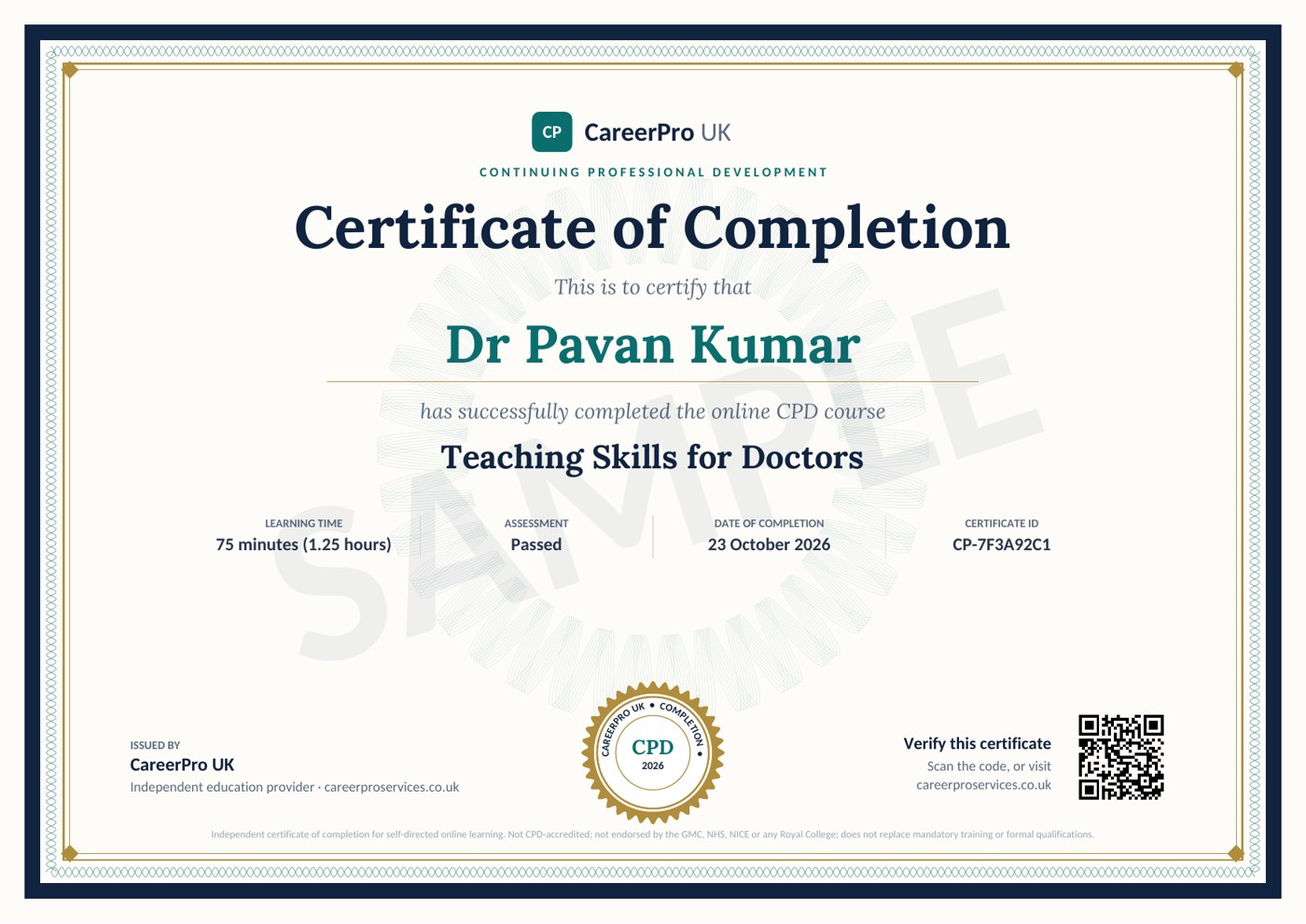
Finish with evidence you can show
Complete the course and pass the short quiz to earn a certificate of completion you can show to shortlisters, appraisers and interview panels.
- A verifiable certificate with a QR code — for your CV, portfolio and appraisal
- An appraisal-ready reflective note, pre-filled with the learning outcomes
- A ready-made CV line and a supporting-statement paragraph for NHS Jobs and Trac
- Add it to your LinkedIn profile in one click
- Pay £7 only at the end, and only if you pass — or save with a bundle
'Evidence of reflective practice' and 'commitment to continuing professional development' appear on almost every NHS person specification — and many international doctors have never had an NHS appraisal. This practical course explains how appraisal and revalidation work, what your designated body and responsible officer do, the six types of supporting information the GMC expects, and how to write reflections that are useful and safe. You practise with real-style examples, write your own reflection, and build a personal development plan (PDP) you can download for your first NHS appraisal or your next interview.
What you'll learn
- Explain why reflective practice matters for patient safety, learning and your career
- Use a simple model (What? So what? Now what?) and Gibbs' cycle to write focused reflections
- Write reflections that are honest, anonymised and safe, in line with UK guidance
- Describe the purpose and process of NHS appraisal, and prepare for it
- Collect the six types of supporting information the GMC expects
- Explain revalidation, designated bodies, responsible officers and suitable persons
- Write a SMART personal development plan
- Describe your reflective practice confidently on your CV and at interview
Course outline
1Why reflection matters
- Welcome — reflection is part of being a UK doctor — In the NHS, doctors are expected to reflect on their practice, take part in appraisal every year, and revalidate with the GMC, usually every five years.
- What is reflective practice? — Reflection is thinking about your experiences in a structured way so that you learn from them and improve your practice. It is not the same as simply remembering what happened, and it is not a confession.
- Why reflection matters — for patients, the NHS and you — Reflection can feel like paperwork. It is worth understanding why the NHS takes it seriously, because once you see the purpose, the writing becomes easier and more useful.
- What can you reflect on? — You can reflect on almost anything in your working life. A clinical case is a natural starting point, whether it involved a difficult diagnosis, an unusual presentation or a good outcome.
2How to reflect well
- A simple model — What? So what? Now what? — You do not need a complicated framework to reflect well. The simplest model, associated with Driscoll, asks three questions. It is quick and works for almost anything: a case, a course, a piece of feedback or a difficult shift.
- Gibbs' reflective cycle — For bigger or more emotional events — a serious incident, a death that affected you, a conflict with a colleague — Gibbs' cycle (1988) gives more structure. It is longer than What? So what?
- Good reflection vs weak reflection — Appraisers read many reflections. The weak ones tend to look alike: a long story, a vague lesson and no change. The strong ones are short, honest and specific. The table below shows the most common differences.
- Writing reflections safely — Some doctors worry that writing honestly about a mistake could be used against them.
- Your turn — write a reflection — Now practise. Choose a real experience from the last few months — clinical or non-clinical. It does not need to be dramatic; ordinary events often give the clearest learning. Use What? So what? Now what?
3Appraisal: how it works
- What is NHS appraisal? — Appraisal is a yearly, confidential, supportive conversation with a trained appraiser (usually another doctor) about your whole practice, your development and your wellbeing.
- Preparing for your appraisal — The quality of your appraisal depends largely on your preparation. Doctors who gather evidence through the year and write a few thoughtful reflections usually have a relaxed, useful meeting.
- The appraisal meeting — The meeting usually lasts 1.5–3 hours and takes place in person or by video, in a private setting.
4Supporting information
- The six types of supporting information — Supporting information is the evidence you bring to appraisal to show what you do, how you keep up to date and how you review your practice. The GMC describes six types.
- CPD — what counts? — Continuing professional development (CPD) is any learning that helps you keep up to date and improve your practice. It is broader than formal courses.
- Significant events, complaints and compliments — These three items are where openness matters most. Appraisers and responsible officers are not looking for doctors who never have anything go wrong — that is not realistic.
- Feedback from colleagues and patients — Formal feedback shows how others experience working with you and being cared for by you. It often reveals things you cannot see yourself — both strengths you take for granted and habits you didn't know you had.
5Revalidation
- Revalidation — keeping your licence to practise — Revalidation is how licensed doctors in the UK show the GMC, usually every five years, that they are up to date and fit to practise. It is based on annual appraisals.
- Revalidation for international doctors — Doctors who join the NHS from overseas sometimes discover, months later, that their revalidation connection was never set up, or that they have gone a year without an appraisal. Both are easy to avoid if you know what to check.
6Your PDP, CV and interviews
- Your personal development plan (PDP) — Your PDP sets out 3–5 development goals for the next year, agreed at appraisal. Good goals come from your feedback, reflections, career plans and the needs of your service.
- Reflection on your CV and at interview — Everything you do for appraisal also builds your career evidence. Shortlisters and interviewers want to see that you reflect, learn and change — and your portfolio gives you real examples to draw on.
- Download your reflection and PDP — Here is everything you have written in this course. Read it through once more, make any final changes, and download it. You can paste it into your appraisal system, share it with your supervisor, or use it to prepare for interview.
- Using this course in your NHS application — Shortlisting for NHS posts is usually done by scoring your application against each criterion in the person specification, which are listed as essential or desirable.
- Summary — Three things to do this week: check your designated body and revalidation date on GMC Online; set up a folder for supporting information; and save the reflection and PDP you wrote in this course.
Frequently asked questions
Is the Reflection, Appraisal & Revalidation course free?
Yes. The Reflection, Appraisal & Revalidation course is free to study online after a quick free sign-up with your name and email. Studying is free. If you want a certificate of completion, it costs £7, and you pay only after you pass the quiz.
Who is this course for?
Foundation — for doctors at every grade, especially those new to the NHS. It is written for NHS doctors and international medical graduates (IMGs).
What will I learn?
You will be able to: explain why reflective practice matters for patient safety, learning and your career; use a simple model (What? So what? Now what?) and Gibbs' cycle to write focused reflections; write reflections that are honest, anonymised and safe, in line with UK guidance; describe the purpose and process of NHS appraisal, and prepare for it; collect the six types of supporting information the GMC expects; explain revalidation, designated bodies, responsible officers and suitable persons; write a SMART personal development plan; describe your reflective practice confidently on your CV and at interview.
How long does it take?
The course has 6 short modules of about 15 minutes each, and your progress is saved so you can stop and come back. Your certificate records your learning time for your appraisal portfolio.
Is the course accredited?
Online course — does not replace GMC or designated body requirements for appraisal and revalidation. The certificate confirms completion of self-directed learning, which you can record in your appraisal portfolio with your own reflection.
Can I use it in my NHS job application?
Yes. List it under 'Courses and CPD' on your CV and in the education or training section of your NHS Jobs or Trac application, and use what you learned as evidence in your supporting statement. The certificate has a QR code so shortlisters can verify it.
✍️ Writing your NHS supporting statement? See an example paragraph for this criterion and examples for every other common person specification point.
Independent study guide by CareerPro UK, reviewed October 2026. About this course
This is an independent study guide to reflective practice, appraisal and revalidation for doctors in the UK, written in our own words from publicly available GMC and NHS guidance. It does not replace the guidance of the GMC, your responsible officer or your designated body, which sets your local requirements. Check your own revalidation date and connection in your GMC Online account.
CareerPro UK is an independent education provider. Our courses are not produced, endorsed, approved or accredited by the General Medical Council (GMC), the NHS, NICE, any Royal College or any other official body, and we are not affiliated with them. Courses are study guides written in our own words from publicly available guidance. They do not replace the official guidance, which can change — always check the current version (e.g. at gmc-uk.org and nice.org.uk). They are not legal or professional advice: for a specific situation, follow your employer's policies and speak to your seniors or your medical defence organisation.
Quiz
Answer all 15 questions. You need 12 correct to pass. You can retake it.
Get your certificate
Your certificate is ready
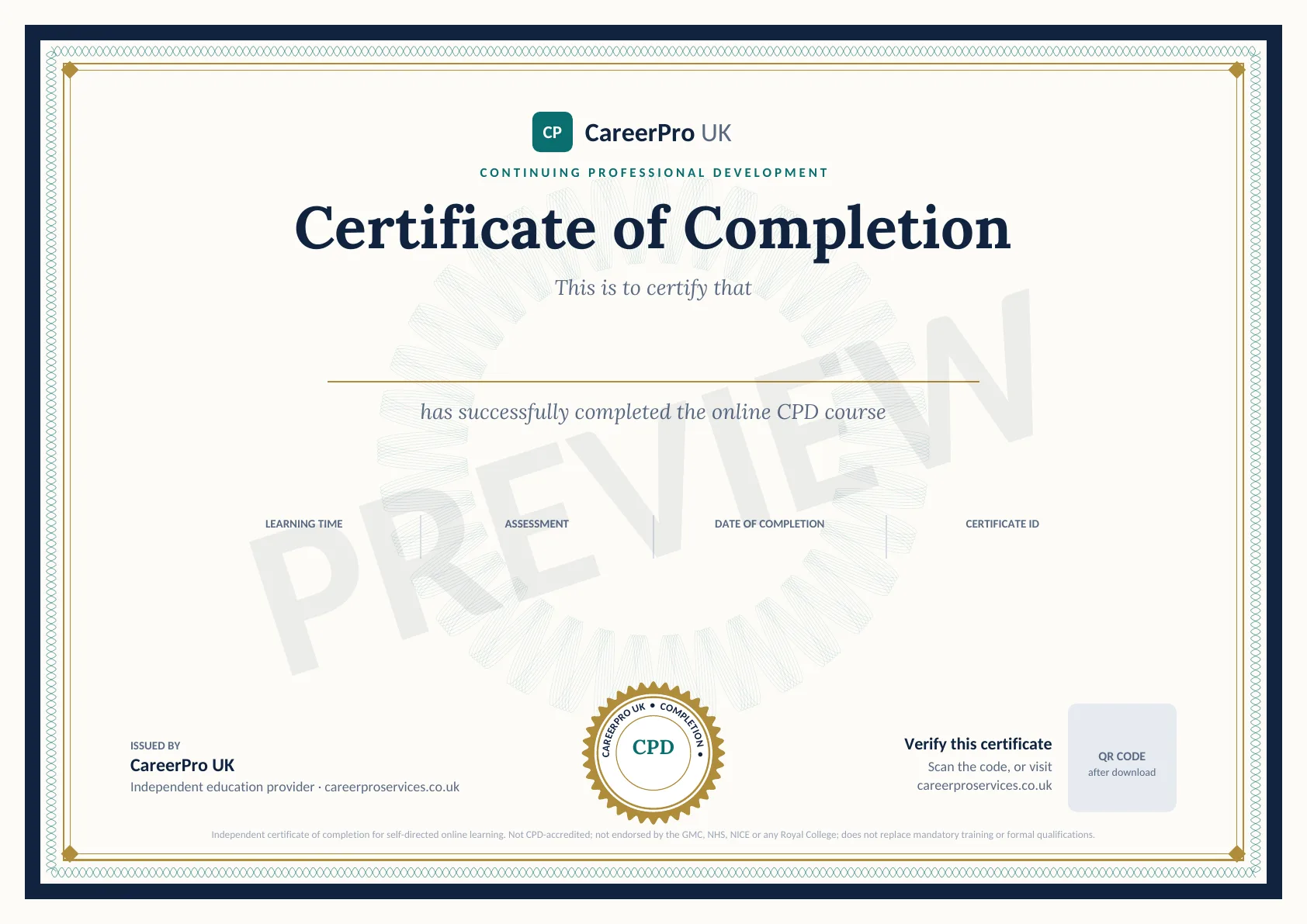
- Your verifiable PDF certificate with a QR code, so shortlisters and appraisers can check it's genuine
- A ready-to-paste line for your NHS Jobs or Trac application and your CV
- An appraisal-ready reflective note, pre-filled with the course's learning outcomes and your CPD time
- One-click add to your LinkedIn profile
The course itself is free. The certificate pack is a one-off £7, with no subscription. Payment is handled securely by Stripe, and we never see your card details.
Have a bundle code?
Taking several courses? Save with a certificate bundle — from £27 for 6 certificates.
Well done — you've passed
Keep the PDF — its QR code lets an appraiser or employer confirm it's genuine.
Independent certificate of completion; not CPD-accredited or endorsed by the GMC, NHS or any Royal College.
Write a quick reflection for your portfolio
Appraisers value reflection more than certificates. Jot down a few lines while it's fresh — it stays on this device until you copy it.
Free sign-up to start this course
Sign up once with your email and you can study every course free. Your certificate is optional and paid only after you pass.
We use your details to give you access to the courses. See our privacy notice.
Get new courses and NHS job alerts
Optional — leave your email if you'd like us to tell you about new CPD courses, NHS job alerts and career support. You can unsubscribe at any time.
See our privacy notice.