Professionalism and Probity for Doctors
Person spec essential Probity and professional integrity are essential criteria for NHS posts
'Probity — professional integrity' is a heading on every NHS medical person specification. Know exactly what UK employers and the GMC expect, and avoid the mistakes that end careers.
- Clear rules on CVs, references, timesheets, gifts, boundaries, social media and AI
- What you must tell the GMC — and how fitness to practise works
- Real-style scenarios and model answers to probity interview questions
- Format
- 6 short modules · about 10 min each · stop and come back any time
- Slides
- 22
- Quiz
- 15 questions
- Pass mark
- 12/15
- Studying
- Free
- Certificate
- £5 after you pass
or save up to 60% with a bundle - Last reviewed
- October 2026 · how we check our courses
Free sign-up with your email unlocks this course and every other course, and your progress is saved on this device. When you pass, get your certificate for £5 — evidence for your CV, appraisal and interviews.

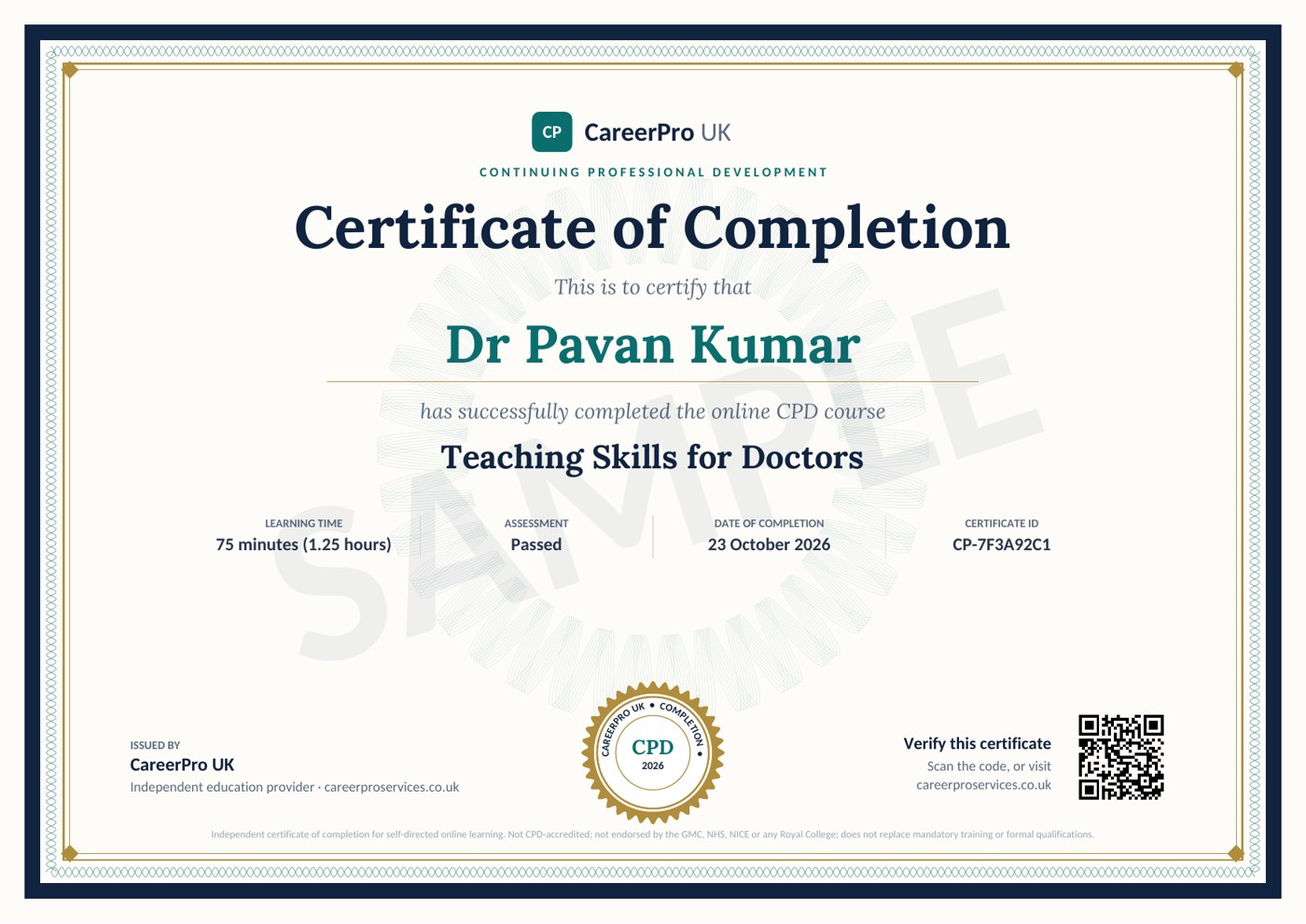
Finish with evidence you can show
Complete the course and pass the short quiz to earn a certificate of completion you can show to shortlisters, appraisers and interview panels.
- A verifiable certificate with a QR code — for your CV, portfolio and appraisal
- An appraisal-ready reflective note, pre-filled with the learning outcomes
- A ready-made CV line and a supporting-statement paragraph for NHS Jobs and Trac
- Add it to your LinkedIn profile in one click
- Pay £5 only at the end, and only if you pass — or save with a bundle
'Probity — professional integrity' is its own heading on NHS medical person specifications at every grade, and probity problems are a common reason doctors are referred to the GMC. This practical course explains what UK patients, employers and the GMC expect: honesty in applications, CVs, references, timesheets and research; conflicts of interest and gifts; personal and professional boundaries, chaperones and social media; your own health; using AI tools honestly; what you must report to the GMC; raising concerns; and how fitness to practise works — with real-style scenarios and model interview answers.
What you'll learn
- Explain professionalism and probity using the four domains of Good Medical Practice 2024
- Be honest and accurate in CVs, applications, references, records, timesheets and research
- Manage conflicts of interest, gifts and financial arrangements appropriately
- Maintain personal and professional boundaries, use chaperones correctly and behave professionally online
- Protect patients from risks related to your own health, and avoid treating yourself or people close to you
- Use AI tools honestly and safely
- Know what you must report to the GMC, and how to raise concerns
- Describe the GMC fitness to practise process and where to get help
Course outline
1What professionalism and probity mean
- Welcome — why probity matters so much — Probity means being honest and trustworthy, and acting with integrity.
- Good Medical Practice 2024 — the four domains — Good Medical Practice is the GMC's core guidance for every registered doctor. The current edition came into effect on 30 January 2024.
- How the GMC thinks about dishonesty — It helps to understand how dishonesty is judged, because many doctors assume that if they 'didn't mean any harm', they cannot be found dishonest. That is not how it works.
- Professional behaviour every day — Professionalism is not only about avoiding serious wrongdoing.
2Honesty in applications, records and money
- Honesty in CVs and applications — Applications are where many IMGs are most at risk, often without realising it. NHS recruitment is competitive, and shortlisting scores depend on audits, teaching, publications and experience.
- References — References are a key safety check in NHS recruitment. Employers rely on them to learn whether a doctor is competent, honest and safe.
- Records, timesheets and money — Medical records, timesheets and expense claims all have one thing in common: other people rely on them without checking. A nurse acts on your note; a payroll team pays your timesheet; a finance officer reimburses your expenses.
- Conflicts of interest and gifts — A conflict of interest arises when something other than the patient's interest could influence — or appear to influence — your professional decisions.
- Honesty in research and education — Research, audit and education all depend on honest data and honest assessment. If research results are invented or changed, patients everywhere may be given treatments that don't work.
3Boundaries, chaperones and social media
- Personal and professional boundaries — A professional boundary is the line between a caring professional relationship and a personal one.
- Intimate examinations and chaperones — Intimate examinations are a necessary part of medicine, but they can be embarrassing, frightening or distressing for patients.
- Social media and online behaviour — Social media blurs the line between private and professional life. A post you think of as personal can be seen by patients, colleagues, employers and the press, and can be screenshotted and shared within minutes.
4Your health, AI and other modern risks
- Your own health — Doctors are often the last people to look after their own health. Long shifts, exams, moving country, being far from family and the pressure to cope can all take a toll.
- Treating yourself, family and friends — In many countries it is normal for doctors to prescribe for their parents, write a quick prescription for a friend, or look up a relative's results. In the UK, GMC guidance says you should avoid this wherever possible.
- Using AI tools honestly and safely — AI tools — from general chatbots to NHS-approved ambient scribes — are increasingly part of medical work. The same principles of honesty, confidentiality and accountability apply.
5Reporting, concerns and the GMC
- What you must tell the GMC — Registration with the GMC comes with duties, and one of the most important is to tell the GMC about certain events in your life, wherever in the world they happen.
- Raising concerns — Probity is not only about your own honesty. It also means not looking away when something is wrong — when patients are at risk, when a colleague is behaving dishonestly or dangerously, or when a system is failing.
- How fitness to practise works — 'Fitness to practise' means whether a doctor is safe and suitable to keep working without restrictions.
- Why international doctors are at higher risk — and how to protect yourself — GMC data show international and ethnic minority doctors are more likely to be referred by employers, often linked to poor induction, isolation and a lack of early feedback.
6Your evidence: CV and interviews
- Probity questions in interviews — Almost every NHS interview includes at least one probity or professionalism question. Panels are not looking for a perfect, memorised answer.
- Using this course in your NHS application — Shortlisting for NHS posts is usually done by scoring your application against each criterion in the person specification, which are listed as essential or desirable.
- Summary — Probity comes down to a simple idea: people must be able to rely on what you say, write and do. Patients, colleagues, employers and the GMC all depend on it. The points below sum up the course.
Frequently asked questions
Is the Professionalism & Probity course free?
Yes. The Professionalism & Probity course is free to study online after a quick free sign-up with your name and email. Studying is free. If you want a certificate of completion, it costs £5, and you pay only after you pass the quiz.
Who is this course for?
Foundation — for doctors at every grade, especially those new to UK practice. It is written for NHS doctors and international medical graduates (IMGs).
What will I learn?
You will be able to: explain professionalism and probity using the four domains of Good Medical Practice 2024; be honest and accurate in CVs, applications, references, records, timesheets and research; manage conflicts of interest, gifts and financial arrangements appropriately; maintain personal and professional boundaries, use chaperones correctly and behave professionally online; protect patients from risks related to your own health, and avoid treating yourself or people close to you; use AI tools honestly and safely; know what you must report to the GMC, and how to raise concerns; describe the GMC fitness to practise process and where to get help.
How long does it take?
The course has 6 short modules of about 10 minutes each, and your progress is saved so you can stop and come back. Your certificate records your learning time for your appraisal portfolio.
Is the course accredited?
Online course — not legal advice. The certificate confirms completion of self-directed learning, which you can record in your appraisal portfolio with your own reflection.
Can I use it in my NHS job application?
Yes. List it under 'Courses and CPD' on your CV and in the education or training section of your NHS Jobs or Trac application, and use what you learned as evidence in your supporting statement. The certificate has a QR code so shortlisters can verify it.
✍️ Writing your NHS supporting statement? See an example paragraph for this criterion and examples for every other common person specification point.
Independent study guide by CareerPro UK, reviewed October 2026. About this course
This is an independent study guide to professionalism and probity for doctors in the UK, written in our own words from publicly available GMC guidance. It is not legal advice. If you are facing a complaint, an investigation or a GMC enquiry, contact your medical defence organisation or union straight away.
CareerPro UK is an independent education provider. Our courses are not produced, endorsed, approved or accredited by the General Medical Council (GMC), the NHS, NICE, any Royal College or any other official body, and we are not affiliated with them. Courses are study guides written in our own words from publicly available guidance. They do not replace the official guidance, which can change — always check the current version (e.g. at gmc-uk.org and nice.org.uk). They are not legal or professional advice: for a specific situation, follow your employer's policies and speak to your seniors or your medical defence organisation.
Quiz
Answer all 15 questions. You need 12 correct to pass. You can retake it.
Get your certificate
Your certificate is ready
- Your verifiable PDF certificate with a QR code, so shortlisters and appraisers can check it's genuine
- A ready-to-paste line for your NHS Jobs or Trac application and your CV
- An appraisal-ready reflective note, pre-filled with the course's learning outcomes and your CPD time
- One-click add to your LinkedIn profile
The course itself is free. The certificate pack is a one-off £5, with no subscription. Payment is handled securely by Stripe, and we never see your card details.
Have a bundle code?
Taking several courses? Save with a certificate bundle — from £27 for 6 certificates.
Well done — you've passed
Keep the PDF — its QR code lets an appraiser or employer confirm it's genuine.
Independent certificate of completion; not CPD-accredited or endorsed by the GMC, NHS or any Royal College.
Write a quick reflection for your portfolio
Appraisers value reflection more than certificates. Jot down a few lines while it's fresh — it stays on this device until you copy it.
Free sign-up to start this course
Sign up once with your email and you can study every course free. Your certificate is optional and paid only after you pass.
We use your details to give you access to the courses. See our privacy notice.
Get new courses and NHS job alerts
Optional — leave your email if you'd like us to tell you about new CPD courses, NHS job alerts and career support. You can unsubscribe at any time.
See our privacy notice.