Working in the NHS: Ward Essentials for IMGs
Best for clinical attachment Built for IMGs on a clinical attachment or who haven't worked in the NHS yet
Never worked in the NHS? Learn how an NHS ward really works before your first shift, and show shortlisters you're ready from day one.
- Board rounds, ward rounds, SBAR handover, NEWS2 escalation and Martha's Rule, explained simply
- Notes, electronic records, safe prescribing, referrals and discharge summaries the NHS way
- Model answers to 'How will you adapt to working in the NHS?' and how to show NHS readiness in your application
- Format
- 6 short modules · about 10 min each · stop and come back any time
- Slides
- 32
- Quiz
- 15 questions
- Pass mark
- 12/15
- Studying
- Free
- Certificate
- £7 after you pass
or save up to 60% with a bundle - Last reviewed
- October 2026 · how we check our courses
No sign-up needed for this course, and your progress is saved on this device. When you pass, get your certificate for £7 — evidence for your CV, appraisal and interviews.

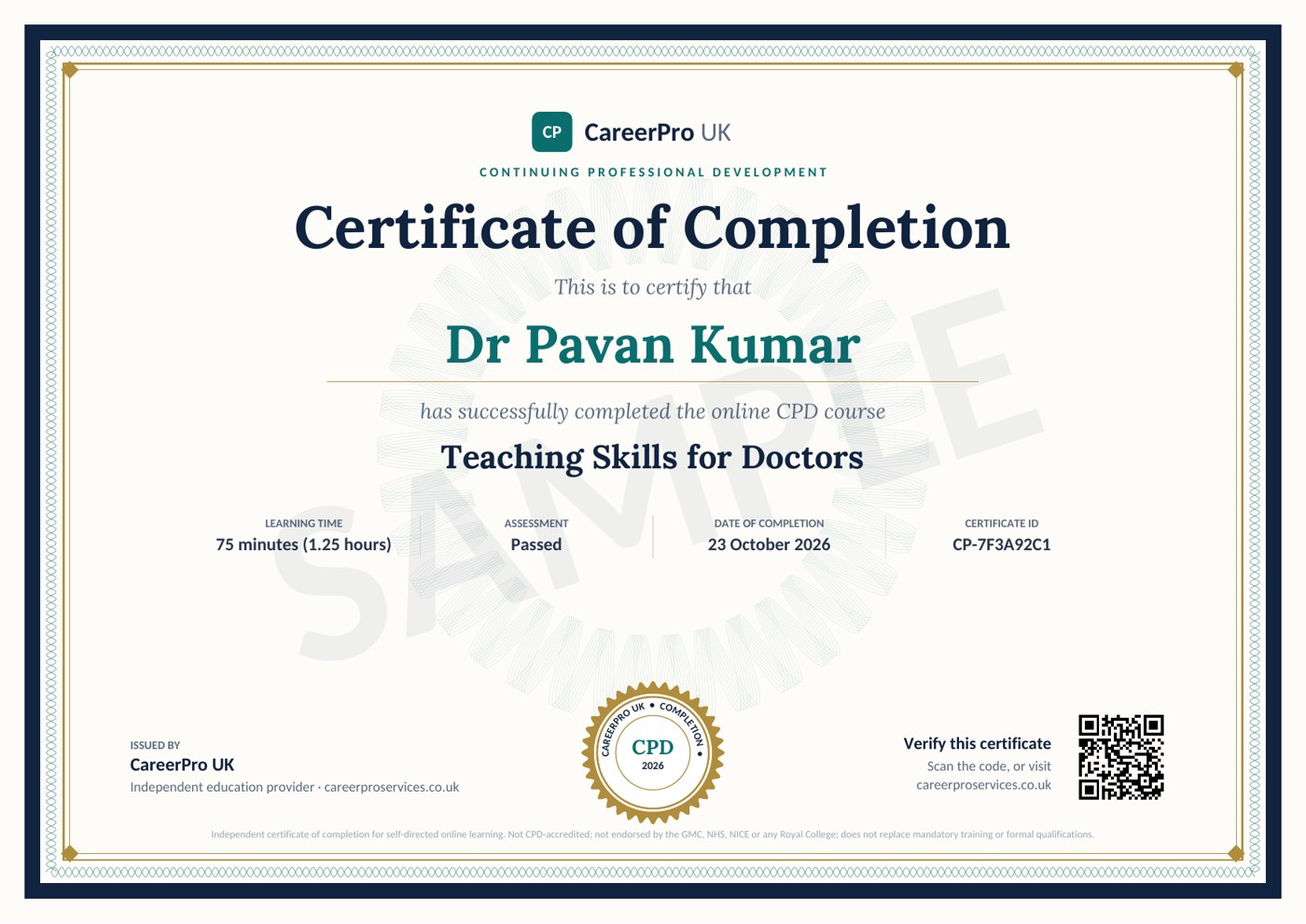
Finish with evidence you can show
Complete the course and pass the short quiz to earn a certificate of completion you can show to shortlisters, appraisers and interview panels.
- A verifiable certificate with a QR code — for your CV, portfolio and appraisal
- An appraisal-ready reflective note, pre-filled with the learning outcomes
- A ready-made CV line and a supporting-statement paragraph for NHS Jobs and Trac
- Add it to your LinkedIn profile in one click
- Pay £7 only at the end, and only if you pass — or save with a bundle
A practical guide to how an NHS hospital ward really works, written for international medical graduates starting their first NHS post or preparing for one. Covers who's who in the team, the ward day, board rounds and ward rounds, handover with SBAR, NEWS2 and escalation, Martha's Rule, documentation and electronic records, safe prescribing basics, requesting investigations and referrals, discharge planning and discharge summaries, induction and mandatory training, rotas, supervision, wellbeing and NHS culture — plus how to show NHS readiness in your application and interview.
What you'll learn
- Describe how NHS hospitals fit into the wider health system, and who does what in a ward team
- Work confidently through a typical ward day: handover, board round, ward round and the jobs list
- Give and receive a safe handover and escalate a deteriorating patient using NEWS2 and SBAR
- Write clear notes, prescribe safely and request investigations and referrals the NHS way
- Plan a safe discharge from day one and write a discharge summary that helps the GP
- Know what to expect from induction, mandatory training, rotas, supervision and wellbeing support
- Show NHS readiness clearly in your supporting statement and at interview
Course outline
1The NHS and your hospital team
- Welcome — about this course — Most international medical graduates arrive in the NHS as experienced, capable doctors. What feels new is rarely the medicine.
- How the NHS fits together — The NHS is free at the point of use for people who live in the UK, paid for mainly through general taxation.
- Who's who on the ward — An NHS ward is run by a large multidisciplinary team (MDT). Doctors are an important part of it, but often not the people who know a patient best.
- Doctor grades — decoding the titles — UK doctor titles confuse almost everyone at first, partly because they have changed over the years and people still use the old names.
- How patients reach your ward — Understanding the patient journey helps you see where you fit and why everyone talks about 'flow'.
2The ward day: board rounds, ward rounds and jobs
- A typical ward day — Every ward has its own rhythm, but most NHS ward days follow a similar shape.
- Board rounds and safety huddles — A board round is a short, fast meeting — often standing at the ward whiteboard or an electronic board — where the team goes through every patient in one or two minutes each. It is not a ward round: patients are not seen.
- The ward round — your role — On the ward round, you will often be the doctor writing in the notes and keeping the jobs list while your registrar or consultant leads. This is a key role.
- The jobs list and prioritising — After the round you will have a long list of jobs and a bleep that won't stop. Prioritising well is one of the most important skills of an NHS ward doctor.
- Bleeps, phones and getting around — Many hospitals still use bleeps (pagers), although more and more use smartphone apps or hospital phones. When you are bleeped, call back promptly.
3Handover, escalation and the deteriorating patient
- Handover with SBAR — Handover is one of the riskiest moments in a patient's care, because information can be lost between teams. NHS hospitals use structured handover, usually based on SBAR, so the key facts are always passed on in the same order.
- NEWS2 — the early warning score — Every adult inpatient in an NHS hospital has regular observations recorded and scored with the National Early Warning Score 2 (NEWS2), developed by the Royal College of Physicians.
- Escalating a sick patient — In the NHS, asking for help early is a sign of a safe doctor, not a weak one. Many serious incidents in UK hospitals involve a delay in recognising or escalating a deteriorating patient. Seniors expect — and want — to be called.
- Martha's Rule and listening to families — Martha Mills died in 2021, aged 13, after her family's concerns about her worsening condition in hospital were not acted on.
- Treatment escalation plans and resuscitation decisions — For many patients — especially older people with frailty or advanced illness — the team should agree early on how far treatment should go if they deteriorate.
4Notes, prescribing, investigations and referrals
- Writing in the notes — In the NHS, the medical record is a legal document, a communication tool for the whole team and, if something goes wrong, the main evidence of what happened.
- Electronic records and your smartcard — Most NHS hospitals now use electronic patient records (EPRs), electronic prescribing and medicines administration (EPMA) and electronic results. Some still use paper notes and drug charts, or a mixture.
- Safe prescribing basics — Prescribing errors are among the most common errors in NHS hospitals. Most are simple — a wrong dose, a missed allergy, a drug that interacts — and most are preventable.
- Requesting investigations — In the NHS, investigations are a shared resource.
- Making a referral to another team — You will regularly refer patients to other specialties — for example cardiology, surgery, renal or psychiatry. Referral systems vary (phone, electronic referral, bleep), so check your trust's process.
5Discharge and working with the wider system
- Planning discharge from day one — In the NHS, discharge planning starts on the day of admission, not the day before the patient leaves.
- Discharge pathways and social care — Many patients — especially older people — need some support after leaving hospital.
- Writing a discharge summary that helps the GP — The discharge summary (also called the discharge letter or TTO letter) tells the GP what happened in hospital and what needs to happen next.
- When a patient dies — Caring for a patient at the end of life, and supporting their family, is one of the most important things you will do.
6Induction, culture, wellbeing and your NHS career
- Your first weeks: induction and mandatory training — Before and during your first weeks you will complete pre-employment checks and an induction. Some of this happens before your start date, so begin early and keep copies of everything.
- Rotas, leave and working hours — Most ward doctors work on a rota that includes normal days, long days, nights and weekends. Your contract and work schedule set out your hours, pay and on-call commitments.
- NHS culture — what surprises IMGs — Many IMGs say the biggest adjustment is cultural, not clinical. The GMC's free 'Welcome to UK Practice' sessions are a good introduction. Here are some of the differences people mention most often.
- Supervision, appraisal and your development — Every doctor in the NHS should have named supervision.
- Looking after yourself — Moving to a new country and a new health system is demanding. Long shifts, unfamiliar systems, being away from family and adjusting to a new culture can all take their toll.
- Showing NHS readiness in your application — Many NHS person specifications list 'experience of working in the NHS' as desirable, not essential. Shortlisters want to know that you will be safe and settle quickly.
- Using this course in your NHS application — Shortlisting for NHS posts is usually done by scoring your application against each criterion in the person specification, which are listed as essential or desirable.
- Summary — None of this replaces your clinical skill — it's the framework that lets your skill reach the patient safely. Learn the system, ask questions, and within a few weeks the NHS will feel like home.
Frequently asked questions
Is the NHS Ward Essentials course free?
Yes. The NHS Ward Essentials course is free to study online, with no sign-up. Studying is free. If you want a certificate of completion, it costs £7, and you pay only after you pass the quiz.
Who is this course for?
Foundation — for doctors new to the NHS, on a clinical attachment, or preparing for NHS interviews. It is written for NHS doctors and international medical graduates (IMGs).
What will I learn?
You will be able to: describe how NHS hospitals fit into the wider health system, and who does what in a ward team; work confidently through a typical ward day: handover, board round, ward round and the jobs list; give and receive a safe handover and escalate a deteriorating patient using NEWS2 and SBAR; write clear notes, prescribe safely and request investigations and referrals the NHS way; plan a safe discharge from day one and write a discharge summary that helps the GP; know what to expect from induction, mandatory training, rotas, supervision and wellbeing support; show NHS readiness clearly in your supporting statement and at interview.
How long does it take?
The course has 6 short modules of about 10 minutes each, and your progress is saved so you can stop and come back. Your certificate records your learning time for your appraisal portfolio.
Is the course accredited?
Online course — does not replace your employer's induction or mandatory training. The certificate confirms completion of self-directed learning, which you can record in your appraisal portfolio with your own reflection.
Can I use it in my NHS job application?
Yes. List it under 'Courses and CPD' on your CV and in the education or training section of your NHS Jobs or Trac application, and use what you learned as evidence in your supporting statement. The certificate has a QR code so shortlisters can verify it.
✍️ Writing your NHS supporting statement? See an example paragraph for this criterion and examples for every other common person specification point.
Independent study guide by CareerPro UK, reviewed October 2026. About this course
This is an independent study guide to everyday ward work in NHS hospitals, written in our own words from publicly available UK sources. It mainly describes hospitals in England; local systems, forms and IT differ between trusts and between the four UK nations. Always follow your trust's induction, policies and the advice of your seniors.
CareerPro UK is an independent education provider. Our courses are not produced, endorsed, approved or accredited by the General Medical Council (GMC), the NHS, NICE, any Royal College or any other official body, and we are not affiliated with them. Courses are study guides written in our own words from publicly available guidance. They do not replace the official guidance, which can change — always check the current version (e.g. at gmc-uk.org and nice.org.uk). They are not legal or professional advice: for a specific situation, follow your employer's policies and speak to your seniors or your medical defence organisation.
Quiz
Answer all 15 questions. You need 12 correct to pass. You can retake it.
Get your certificate
Your certificate is ready
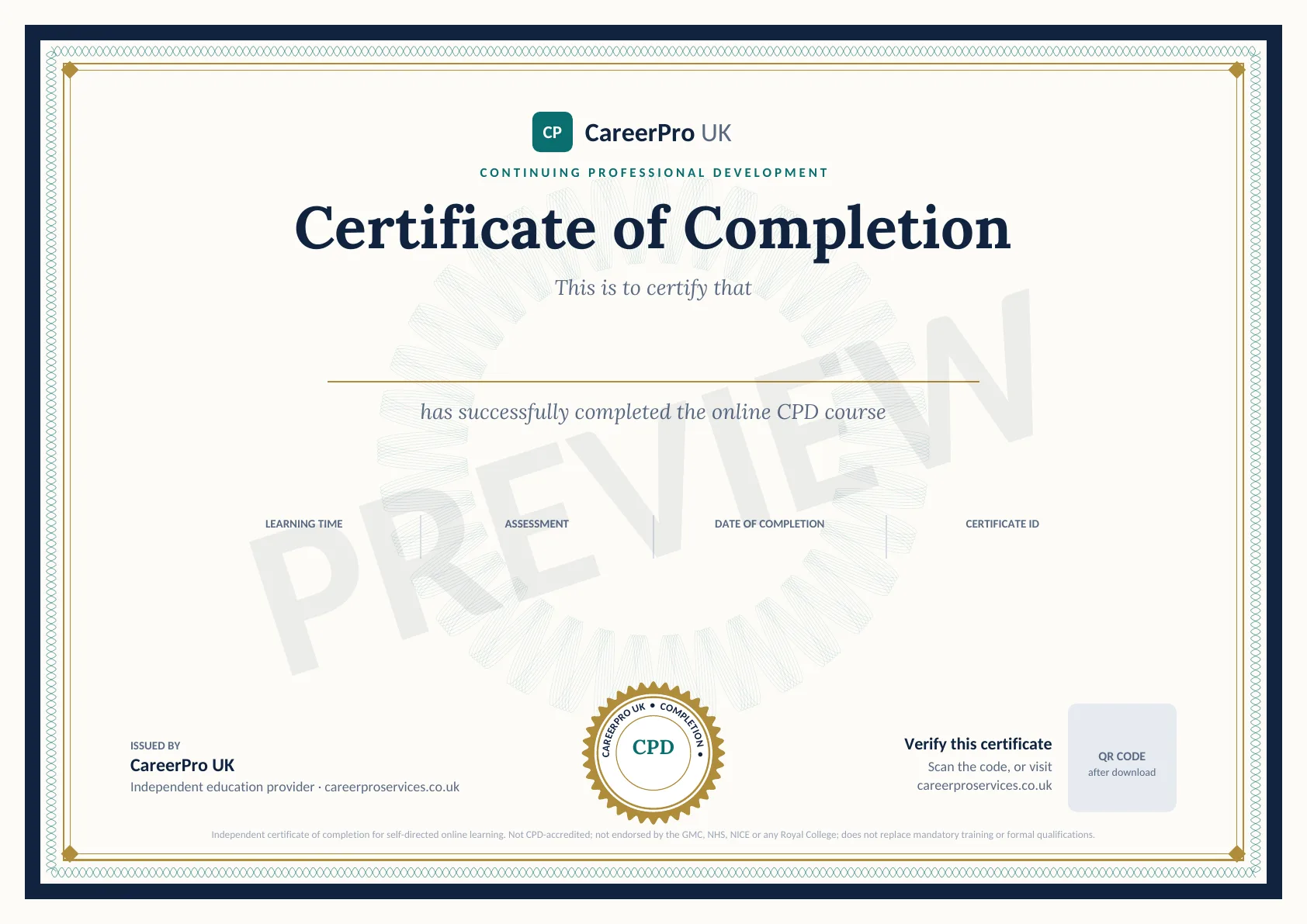
- Your verifiable PDF certificate with a QR code, so shortlisters and appraisers can check it's genuine
- A ready-to-paste line for your NHS Jobs or Trac application and your CV
- An appraisal-ready reflective note, pre-filled with the course's learning outcomes and your CPD time
- One-click add to your LinkedIn profile
The course itself is free. The certificate pack is a one-off £7, with no subscription. Payment is handled securely by Stripe, and we never see your card details.
Have a bundle code?
Taking several courses? Save with a certificate bundle — from £27 for 6 certificates.
Well done — you've passed
Keep the PDF — its QR code lets an appraiser or employer confirm it's genuine.
Independent certificate of completion; not CPD-accredited or endorsed by the GMC, NHS or any Royal College.
Write a quick reflection for your portfolio
Appraisers value reflection more than certificates. Jot down a few lines while it's fresh — it stays on this device until you copy it.
Free sign-up to start this course
Sign up once with your email and you can study every course free. Your certificate is optional and paid only after you pass.
We use your details to give you access to the courses. See our privacy notice.
Get new courses and NHS job alerts
Optional — leave your email if you'd like us to tell you about new CPD courses, NHS job alerts and career support. You can unsubscribe at any time.
See our privacy notice.