Mental Health Act and Mental Capacity Act for Doctors
Essential for psychiatry Psychiatry posts expect MHA and MCA knowledge
Every doctor uses the Mental Capacity Act and meets the Mental Health Act — on the wards, in ED and in psychiatry. Know which law applies, and say it precisely at interview.
- Clear answers to everyday dilemmas: the patient who wants to leave, restraint, self-harm and refusal
- Up to date with 2026: the Supreme Court's deprivation of liberty ruling and the Mental Health Act 2025
- A capacity assessment template you can download and use on your next shift
- Format
- 6 short modules · about 15 min each · stop and come back any time
- Slides
- 24
- Quiz
- 15 questions
- Pass mark
- 12/15
- Studying
- Free
- Certificate
- £9 after you pass
or save up to 60% with a bundle - Last reviewed
- October 2026 · how we check our courses
Free sign-up with your email unlocks this course and every other course, and your progress is saved on this device. When you pass, get your certificate for £9 — evidence for your CV, appraisal and interviews.

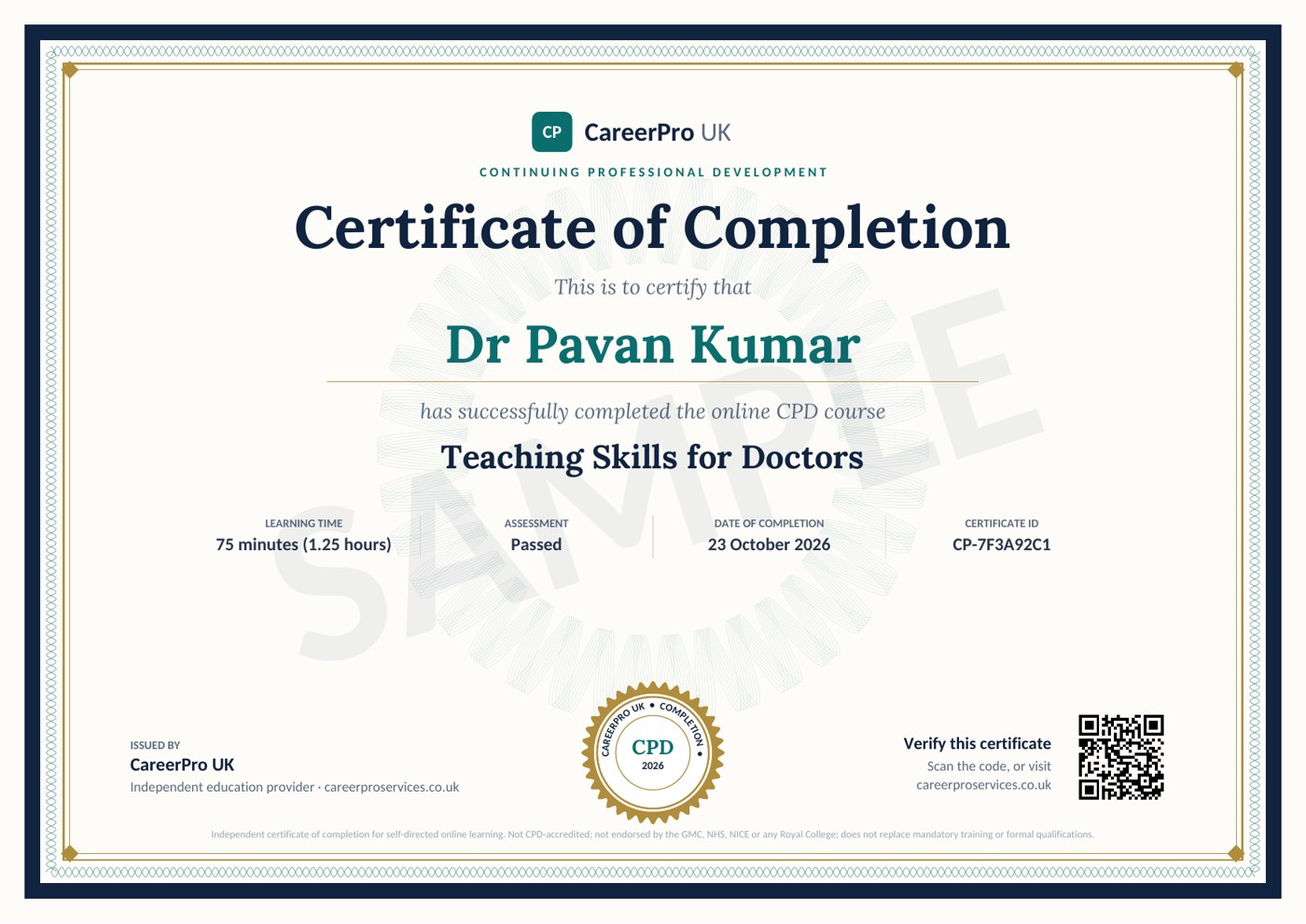
Finish with evidence you can show
Complete the course and pass the short quiz to earn a certificate of completion you can show to shortlisters, appraisers and interview panels.
- A verifiable certificate with a QR code — for your CV, portfolio and appraisal
- An appraisal-ready reflective note, pre-filled with the learning outcomes
- A ready-made CV line and a supporting-statement paragraph for NHS Jobs and Trac
- Add it to your LinkedIn profile in one click
- Pay £9 only at the end, and only if you pass — or save with a bundle
Every doctor meets these laws — in the emergency department, on medical and surgical wards, in psychiatry and in general practice. This practical course explains which law to use and when: assessing capacity step by step, best interests and restraint, the patient who wants to leave, self-harm and refusal of treatment, the key Mental Health Act sections (2, 3, 4, 5(2), 5(4), 135, 136, 17, 117 and CTOs), consent to treatment, patients' rights, deprivation of liberty after the June 2026 Supreme Court judgment, and what the Mental Health Act 2025 will change. Includes real cases and a capacity assessment template you can download.
What you'll learn
- Explain the different purposes of the Mental Health Act 1983 and the Mental Capacity Act 2005, and choose the right one
- Assess and document capacity for a specific decision using the current two-stage approach
- Make best-interests decisions and use restraint lawfully and proportionately
- Describe how the June 2026 Supreme Court judgment changed deprivation of liberty, and when DoLS applies
- Explain sections 2, 3, 4, 5(2), 5(4), 135 and 136, leave, aftercare and CTOs — and who can use each
- Describe consent-to-treatment rules, patients' rights and the role of the tribunal
- Manage common situations: a patient leaving, self-harm and refusal, and a mental health crisis in ED
- Summarise what the Mental Health Act 2025 will change
Course outline
1Foundations: two laws, two purposes
- Welcome — the laws every doctor uses — A confused patient pulling out a cannula. A man with psychosis trying to leave a medical ward. A young woman refusing treatment after an overdose.
- Why this matters — and what is expected of you — Mental health and capacity law exists to balance two things that can pull in opposite directions: a person's right to make their own choices and to be free, and the duty to protect people who cannot protect themselves.
- Two laws, two purposes — The Mental Capacity Act 2005 (MCA) is about decisions.
- The five principles of the Mental Capacity Act — Section 1 of the MCA sets out five principles. They are not just background — they guide every capacity assessment and every decision you make for someone who lacks capacity.
2The Mental Capacity Act in practice
- Assessing capacity — step by step — You should assess capacity whenever there is a reason to doubt it — for example the person is confused, drowsy, intoxicated, very distressed, has a condition that affects the brain, or is making a decision that does not seem to fit with what you know of them.
- Recording a capacity assessment — A capacity assessment that is not written down is very hard to defend. Your notes protect the patient, show the next team what you found, and show that you followed the law.
- Best interests — If a person lacks capacity, any decision made for them must be in their best interests (MCA section 4). This is not what you think is best medically; it includes the whole person.
- LPAs, deputies, advance decisions and IMCAs — Before you make a best-interests decision, always check whether someone else has the legal right to decide, or whether the patient has already decided in advance. This is one of the commonest gaps in hospital practice.
3Liberty, restraint and the patient who wants to leave
- Restraint — when it is lawful — Restraint is wider than holding someone down.
- The patient who wants to leave — Few situations cause more anxiety on call than a patient walking towards the door. The key is to stay calm and think in order: why do they want to go, do they have capacity to decide to leave, and is a mental disorder involved?
- Deprivation of liberty after June 2026 — Being deprived of liberty means much more than being locked in a cell.
4The Mental Health Act: key sections
- The Mental Health Act — who's who — The Mental Health Act deliberately shares power between several people, so that no single professional can detain someone on their own.
- Sections 2, 3 and 4 — These three sections are the main ways a person can be admitted to hospital against their wishes under the Mental Health Act.
- Holding powers: sections 5(2) and 5(4) — Sometimes a patient who is already in hospital voluntarily (an 'informal' patient) suddenly wants to leave, and there is serious concern that a mental disorder is putting them or others at risk.
- Sections 135 and 136 — police powers — Sections 135 and 136 allow the police to take a person who may have a mental disorder to a place of safety so that they can be properly assessed.
- Leave, aftercare and community treatment orders — Being detained does not mean being kept on a locked ward for the whole time.
5Treatment, rights and safeguards
- Treatment under the Mental Health Act — Detention under the Mental Health Act allows more than keeping someone in hospital. For many patients, it also allows treatment for their mental disorder even when they refuse.
- Patients' rights and safeguards — Detention is one of the most serious things the state can do to a person who has not committed a crime.
- Self-harm and refusal of treatment — These are among the hardest situations in medicine. You are balancing a person's right to refuse treatment against your duty to protect life, often at night, under time pressure, with a distressed patient.
6Changes, cases and your career
- What the Mental Health Act 2025 will change — The Mental Health Act 1983 has been criticised for many years: concerns included rising numbers of detentions, people with autism or a learning disability spending long periods in hospital, too little say for patients over their own care, and the over-representation of people from some ethnic minority groups — particularly Black people — among those detained.
- Put it together — which law? — Real patients rarely arrive labelled 'MCA case' or 'MHA case'.
- Your capacity template, CV and interviews — For your CV and portfolio, include this certificate, plus a reflection on a real (anonymised) capacity or MHA case.
- Using this course in your NHS application — Shortlisting for NHS posts is usually done by scoring your application against each criterion in the person specification, which are listed as essential or desirable.
- Summary — You do not need to remember every section number to practise safely.
Frequently asked questions
Is the Mental Health Act & MCA course free?
Yes. The Mental Health Act & MCA course is free to study online after a quick free sign-up with your name and email. Studying is free. If you want a certificate of completion, it costs £9, and you pay only after you pass the quiz.
Who is this course for?
Foundation to intermediate — for doctors in every specialty, including psychiatry, and international medical graduates. It is written for NHS doctors and international medical graduates (IMGs).
What will I learn?
You will be able to: explain the different purposes of the Mental Health Act 1983 and the Mental Capacity Act 2005, and choose the right one; assess and document capacity for a specific decision using the current two-stage approach; make best-interests decisions and use restraint lawfully and proportionately; describe how the June 2026 Supreme Court judgment changed deprivation of liberty, and when DoLS applies; explain sections 2, 3, 4, 5(2), 5(4), 135 and 136, leave, aftercare and CTOs — and who can use each; describe consent-to-treatment rules, patients' rights and the role of the tribunal; manage common situations: a patient leaving, self-harm and refusal, and a mental health crisis in ED; summarise what the Mental Health Act 2025 will change.
How long does it take?
The course has 6 short modules of about 15 minutes each, and your progress is saved so you can stop and come back. Your certificate records your learning time for your appraisal portfolio.
Is the course accredited?
Online course — not legal training and not approval under section 12 of the Mental Health Act. The certificate confirms completion of self-directed learning, which you can record in your appraisal portfolio with your own reflection.
Can I use it in my NHS job application?
Yes. List it under 'Courses and CPD' on your CV and in the education or training section of your NHS Jobs or Trac application, and use what you learned as evidence in your supporting statement. The certificate has a QR code so shortlisters can verify it.
✍️ Writing your NHS supporting statement? See an example paragraph for this criterion and examples for every other common person specification point.
Independent study guide by CareerPro UK, reviewed October 2026. About this course
This is an independent study guide to the Mental Health Act 1983 and the Mental Capacity Act 2005 in England and Wales, written in our own words from publicly available law and guidance. It is not legal advice. Mental health law is changing: the Mental Health Act 2025 will be brought into force in phases, and the law on deprivation of liberty changed in June 2026. Scotland and Northern Ireland have different laws. Always follow your trust's current policies and seek advice from your senior, the Mental Health Act office or your legal team.
CareerPro UK is an independent education provider. Our courses are not produced, endorsed, approved or accredited by the General Medical Council (GMC), the NHS, NICE, any Royal College or any other official body, and we are not affiliated with them. Courses are study guides written in our own words from publicly available guidance. They do not replace the official guidance, which can change — always check the current version (e.g. at gmc-uk.org and nice.org.uk). They are not legal or professional advice: for a specific situation, follow your employer's policies and speak to your seniors or your medical defence organisation.
Quiz
Answer all 15 questions. You need 12 correct to pass. You can retake it.
Get your certificate
Your certificate is ready
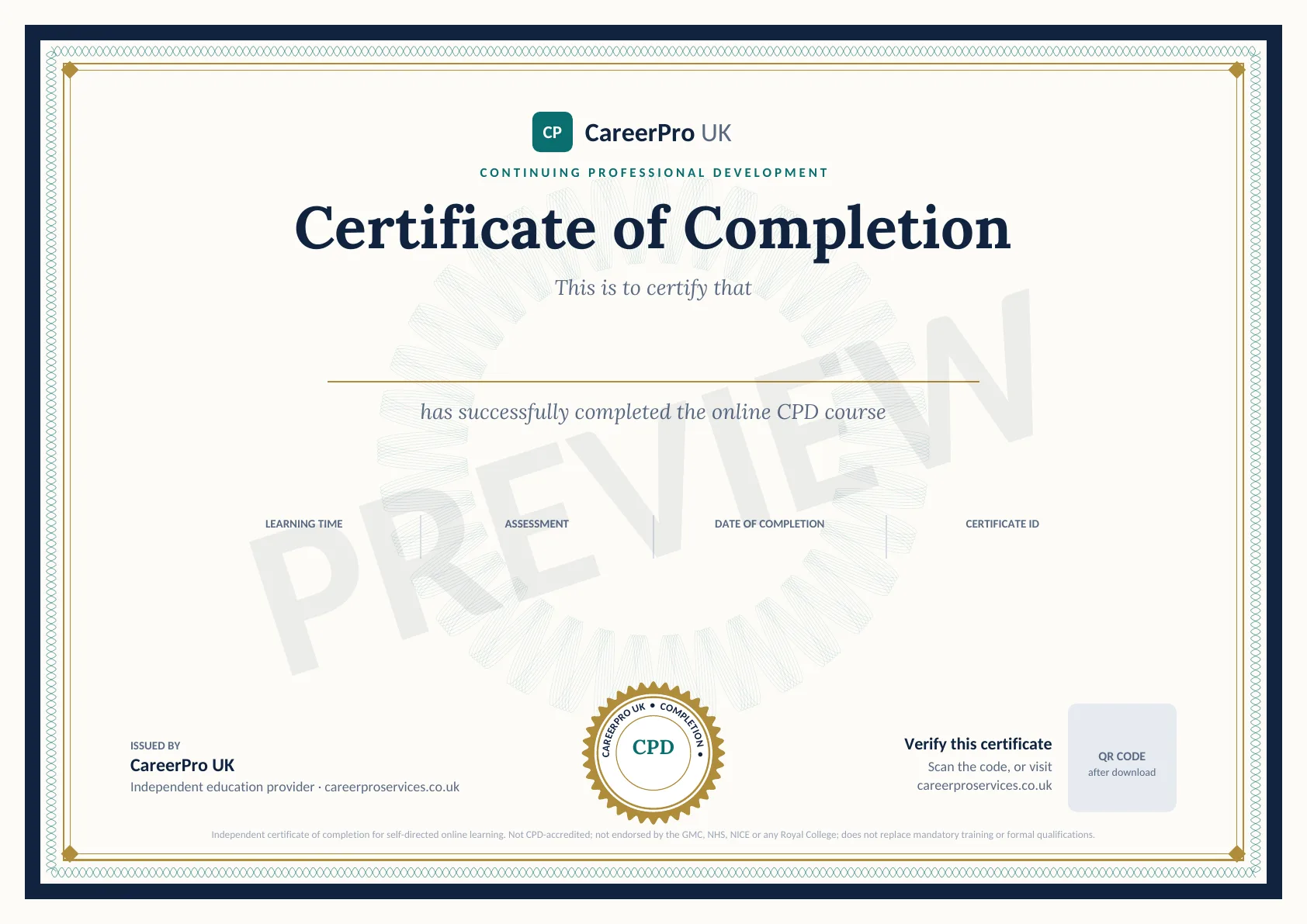
- Your verifiable PDF certificate with a QR code, so shortlisters and appraisers can check it's genuine
- A ready-to-paste line for your NHS Jobs or Trac application and your CV
- An appraisal-ready reflective note, pre-filled with the course's learning outcomes and your CPD time
- One-click add to your LinkedIn profile
The course itself is free. The certificate pack is a one-off £9, with no subscription. Payment is handled securely by Stripe, and we never see your card details.
Have a bundle code?
Taking several courses? Save with a certificate bundle — from £27 for 6 certificates.
Well done — you've passed
Keep the PDF — its QR code lets an appraiser or employer confirm it's genuine.
Independent certificate of completion; not CPD-accredited or endorsed by the GMC, NHS or any Royal College.
Write a quick reflection for your portfolio
Appraisers value reflection more than certificates. Jot down a few lines while it's fresh — it stays on this device until you copy it.
Free sign-up to start this course
Sign up once with your email and you can study every course free. Your certificate is optional and paid only after you pass.
We use your details to give you access to the courses. See our privacy notice.
Get new courses and NHS job alerts
Optional — leave your email if you'd like us to tell you about new CPD courses, NHS job alerts and career support. You can unsubscribe at any time.
See our privacy notice.