Leadership and Management for Doctors
High demand · Interview favourite Leadership is on most person specifications, and leadership questions come up in almost every NHS interview
Leadership is on almost every NHS person specification. Learn to recognise the leadership you already show — and describe it in the language panels look for.
- Practical skills for every shift: briefing a team, leading an emergency, prioritising, delegating and escalating
- The NHS frameworks interviewers recognise: the Healthcare Leadership Model, FMLM standards and GMC guidance
- Build three STAR leadership examples as you go, ready to download for your CV and interview
- Format
- 6 short modules · about 15 min each · stop and come back any time
- Slides
- 29
- Quiz
- 15 questions
- Pass mark
- 12/15
- Studying
- Free
- Certificate
- £7 after you pass
or save up to 60% with a bundle - Last reviewed
- October 2026 · how we check our courses
Free sign-up with your email unlocks this course and every other course, and your progress is saved on this device. When you pass, get your certificate for £7 — evidence for your CV, appraisal and interviews.

Finish with evidence you can show
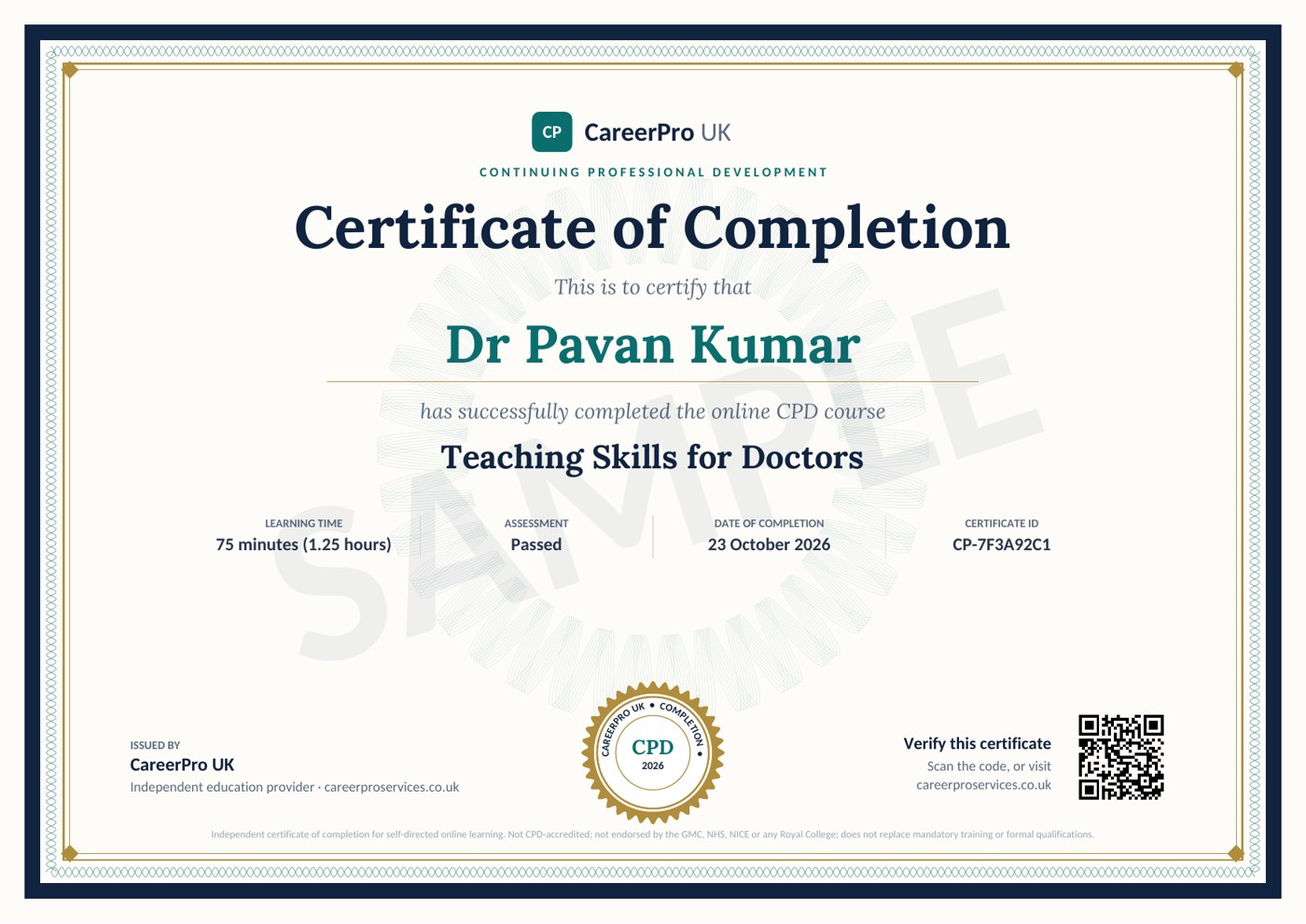
Complete the course and pass the short quiz to earn a certificate of completion you can show to shortlisters, appraisers and interview panels.
- A verifiable certificate with a QR code — for your CV, portfolio and appraisal
- An appraisal-ready reflective note, pre-filled with the learning outcomes
- A ready-made CV line and a supporting-statement paragraph for NHS Jobs and Trac
- Add it to your LinkedIn profile in one click
- Pay £7 only at the end, and only if you pass — or save with a bundle
Leadership is on almost every NHS person specification — for trust grade, specialty and specialist doctors, registrars and consultants. This interactive course shows you what leadership means for every doctor (not just managers), how to lead yourself and a team, run a busy on-call, delegate and escalate, handle conflict, lead change, understand how the NHS is organised and managed — and how to turn your own experience into strong examples. You build three STAR leadership examples as you go, ready to download for your CV, Trac application and interview.
What you'll learn
- Explain the difference between leadership and management, and the GMC's expectations of every doctor
- Use the Healthcare Leadership Model and FMLM standards to describe your own leadership
- Adapt your leadership style to the situation, and lead with compassion and civility
- Build psychological safety, brief a team and lead an emergency using clear communication
- Prioritise, delegate and escalate safely on a busy on-call shift
- Explain how the NHS is organised and the basics of rotas, job plans and resources
- Handle conflict, lead change and influence people you don't manage
- Turn your experience into three STAR leadership examples for your CV and interview
Course outline
1What leadership means for every doctor
- Welcome — you are already a leader — Many doctors think leadership means being a clinical director. In the NHS it means something much broader: every doctor leads — a ward round, a cardiac arrest, a handover, a teaching session, a quality improvement project.
- Why leadership matters in the NHS — Healthcare is delivered by teams, not by individual doctors.
- Leadership in the NHS may feel different — Many international medical graduates come from health systems with a steep hierarchy, where the consultant's word is final, nurses rarely question doctors, and junior doctors do not challenge seniors.
- Leadership and management — what's the difference? — People often use 'leadership' and 'management' as if they meant the same thing. They are related but different, and understanding the difference helps you describe your own work more precisely.
- What the GMC expects of every doctor — The GMC's guidance 'Leadership and management for all doctors' (effective 2012, updated December 2024) applies to all doctors, not only those in management roles. It sits alongside Good Medical Practice 2024.
- NHS leadership frameworks — Two frameworks help you describe your leadership in language NHS panels recognise.
2Leading yourself
- Leading yourself — self-awareness — You cannot lead others well without understanding yourself: your strengths, how you react under pressure, and how others experience you.
- Leadership styles — choose the right one — There is no single 'best' leadership style. Daniel Goleman described six styles that effective leaders use, and the key finding is that good leaders switch between them depending on the situation.
- Compassionate leadership and civility — Compassionate leadership, described by Professor Michael West and promoted across the NHS, has four parts:
- Wellbeing — sustaining yourself and your team — Looking after yourself is part of leading well. Take breaks, eat and drink, and make it normal for your team to do the same. Lead by example, too, by leaving on time when you can and handing over properly.
3Leading teams and the on-call shift
- How teams develop — Bruce Tuckman described the stages most teams go through. Medical teams re-form constantly — with every rotation and every shift — so good leaders help them move quickly to 'performing'.
- Psychological safety — people must feel safe to speak up — Psychological safety (Amy Edmondson) is the shared belief that it is safe to ask questions, admit mistakes and raise concerns without being humiliated. Teams with high psychological safety catch errors earlier and learn faster.
- Briefing, handover and SBAR — Clear, structured communication is one of the most practical leadership skills you can have.
- Leading in an emergency — In an emergency — a cardiac arrest, a peri-arrest call, a major haemorrhage — the team often forms in seconds from people who may never have worked together.
- The on-call shift — prioritising, delegating, escalating — The on-call shift is where most doctors first lead in the NHS. You may be the only doctor covering several wards, with a bleep that does not stop.
4Managing: time, people and resources
- Managing your time — Time is the resource doctors feel shortest of. Managing it well is a leadership skill, because your choices affect patients and colleagues as well as you.
- How the NHS is organised (England) — Understanding how the NHS is organised helps you see why decisions are made the way they are, who to approach to change something, and how your work fits into the wider system.
- Rotas, job plans and leave — the basics — Rotas and job plans can seem like administration, but they directly affect patient safety, training and wellbeing. A rota with gaps means wards without doctors; a job plan with no protected time means no audit or teaching.
- Resources, money and business cases — Every doctor uses NHS resources, and the GMC expects you to use them responsibly and fairly. If you want to change a service, you may need a business case.
5Conflict, change and influence
- Handling conflict — Conflict is a normal part of working in busy teams: disagreements about a patient's plan, a bed, a referral, workload, or the way someone spoke to you. Handled well, conflict can lead to better decisions.
- Difficult conversations with colleagues — Raising a concern about a colleague's behaviour or practice is one of the hardest things a doctor does — especially if that colleague is more senior.
- Leading change — Most change in the NHS fails not because the idea is bad, but because people were not engaged. John Kotter's eight steps give a structure.
- Influencing without authority — Most doctors need to influence people they don't manage: other specialties, managers, nurses, patients. This is the 'influencing for results' dimension.
6Your evidence: CV, portfolio and interview
- Leadership examples you already have — Most doctors have more leadership experience than they realise. The problem is usually not a lack of examples but not recognising them as leadership, and not describing them clearly.
- Make it reflective — Panels hear many examples. What makes yours stand out is reflection — what you learned and how you have changed — and linking it to a recognised framework.
- Common leadership interview questions — Leadership questions come up in almost every NHS interview. They are predictable, which means you can prepare. The table shows common questions and what the panel is really listening for.
- Your leadership portfolio — download it — Now build two more examples (or come back later — they are saved on this device). Aim for variety: one clinical (e.g. leading on call), one non-clinical (e.g. a rota or teaching programme), one improvement (e.g. a QIP).
- Using this course in your NHS application — Shortlisting for NHS posts is usually done by scoring your application against each criterion in the person specification, which are listed as essential or desirable.
- Summary
Frequently asked questions
Is the Leadership & Management course free?
Yes. The Leadership & Management course is free to study online after a quick free sign-up with your name and email. Studying is free. If you want a certificate of completion, it costs £7, and you pay only after you pass the quiz.
Who is this course for?
Foundation to intermediate — for doctors at every grade, including international medical graduates. It is written for NHS doctors and international medical graduates (IMGs).
What will I learn?
You will be able to: explain the difference between leadership and management, and the GMC's expectations of every doctor; use the Healthcare Leadership Model and FMLM standards to describe your own leadership; adapt your leadership style to the situation, and lead with compassion and civility; build psychological safety, brief a team and lead an emergency using clear communication; prioritise, delegate and escalate safely on a busy on-call shift; explain how the NHS is organised and the basics of rotas, job plans and resources; handle conflict, lead change and influence people you don't manage; turn your experience into three STAR leadership examples for your CV and interview.
How long does it take?
The course has 6 short modules of about 15 minutes each, and your progress is saved so you can stop and come back. Your certificate records your learning time for your appraisal portfolio.
Is the course accredited?
Online course — not a formal leadership qualification. The certificate confirms completion of self-directed learning, which you can record in your appraisal portfolio with your own reflection.
Can I use it in my NHS job application?
Yes. List it under 'Leadership and management' on your CV and in the education or training section of your NHS Jobs or Trac application, and use what you learned as evidence in your supporting statement. The certificate has a QR code so shortlisters can verify it.
✍️ Writing your NHS supporting statement? See an example paragraph for this criterion and examples for every other common person specification point.
Independent study guide by CareerPro UK, reviewed October 2026. About this course
This is an independent study guide to leadership and management for doctors, written in our own words from publicly available UK guidance (including the GMC's Leadership and management for all doctors) and widely taught leadership theory. It is not a leadership qualification and is not endorsed by the NHS Leadership Academy, the Faculty of Medical Leadership and Management or the GMC. NHS structures are changing — check current arrangements in your organisation.
CareerPro UK is an independent education provider. Our courses are not produced, endorsed, approved or accredited by the General Medical Council (GMC), the NHS, NICE, any Royal College or any other official body, and we are not affiliated with them. Courses are study guides written in our own words from publicly available guidance. They do not replace the official guidance, which can change — always check the current version (e.g. at gmc-uk.org and nice.org.uk). They are not legal or professional advice: for a specific situation, follow your employer's policies and speak to your seniors or your medical defence organisation.
Quiz
Answer all 15 questions. You need 12 correct to pass. You can retake it.
Get your certificate
Your certificate is ready
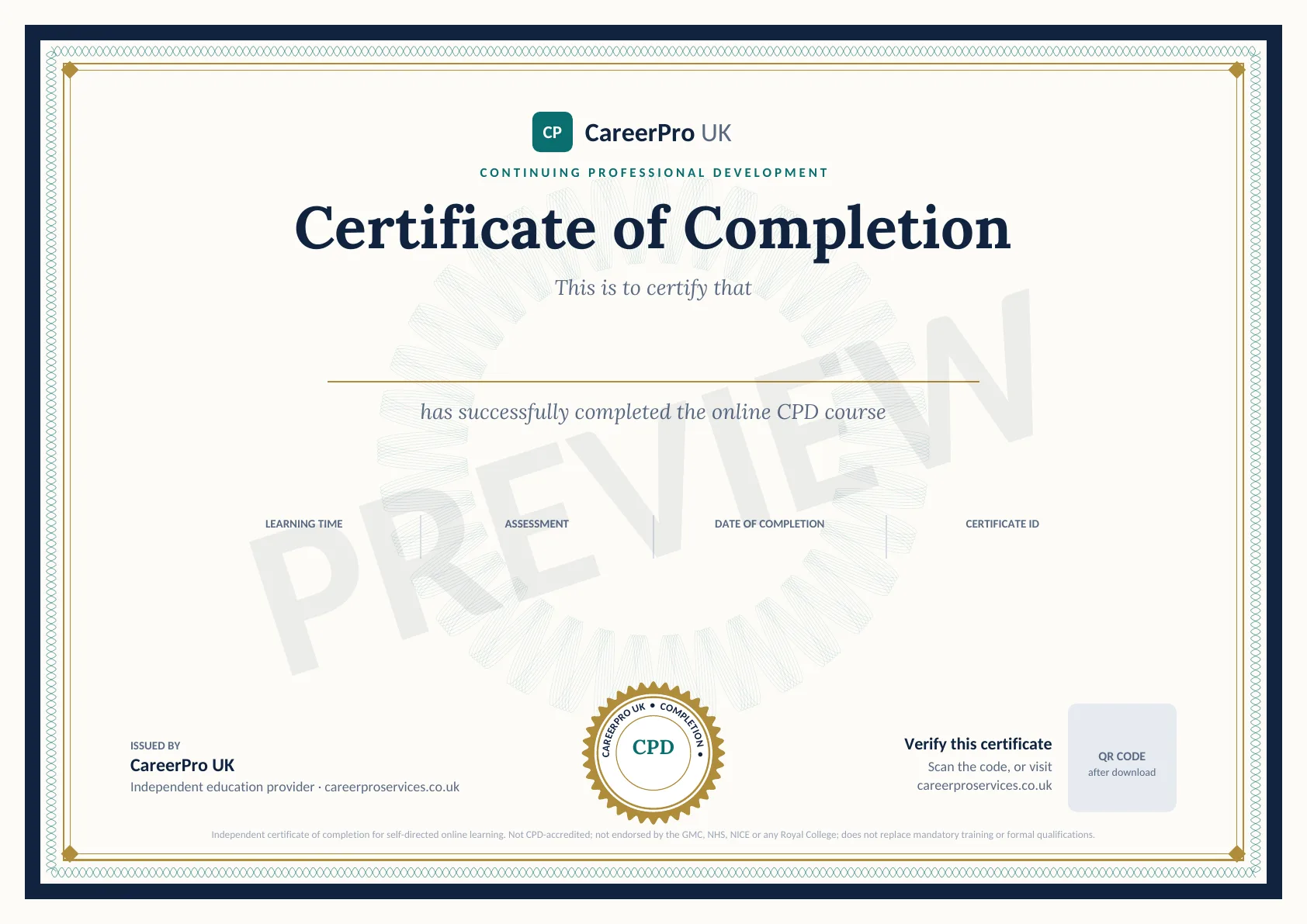
- Your verifiable PDF certificate with a QR code, so shortlisters and appraisers can check it's genuine
- A ready-to-paste line for your NHS Jobs or Trac application and your CV
- An appraisal-ready reflective note, pre-filled with the course's learning outcomes and your CPD time
- One-click add to your LinkedIn profile
The course itself is free. The certificate pack is a one-off £7, with no subscription. Payment is handled securely by Stripe, and we never see your card details.
Have a bundle code?
Taking several courses? Save with a certificate bundle — from £27 for 6 certificates.
Well done — you've passed
Keep the PDF — its QR code lets an appraiser or employer confirm it's genuine.
Independent certificate of completion; not CPD-accredited or endorsed by the GMC, NHS or any Royal College.
Write a quick reflection for your portfolio
Appraisers value reflection more than certificates. Jot down a few lines while it's fresh — it stays on this device until you copy it.
Free sign-up to start this course
Sign up once with your email and you can study every course free. Your certificate is optional and paid only after you pass.
We use your details to give you access to the courses. See our privacy notice.
Get new courses and NHS job alerts
Optional — leave your email if you'd like us to tell you about new CPD courses, NHS job alerts and career support. You can unsubscribe at any time.
See our privacy notice.