Communication Skills for Doctors: Bad News, Complaints and Difficult Conversations
High demand Excellent communication is an essential criterion on every NHS person specification
Communication is on every NHS person specification and tested in almost every interview. Learn the structure and words UK panels and patients expect.
- Model phrases for the hardest conversations: bad news, an angry relative, saying sorry, DNACPR
- Up to date with UK law and guidance: Montgomery, duty of candour and Martha's Rule
- Ready for interview role-plays — and a conversation plan you can download
- Format
- 6 short modules · about 15 min each · stop and come back any time
- Slides
- 24
- Quiz
- 15 questions
- Pass mark
- 12/15
- Studying
- Free
- Certificate
- £7 after you pass
or save up to 60% with a bundle - Last reviewed
- October 2026 · how we check our courses
Free sign-up with your email unlocks this course and every other course, and your progress is saved on this device. When you pass, get your certificate for £7 — evidence for your CV, appraisal and interviews.

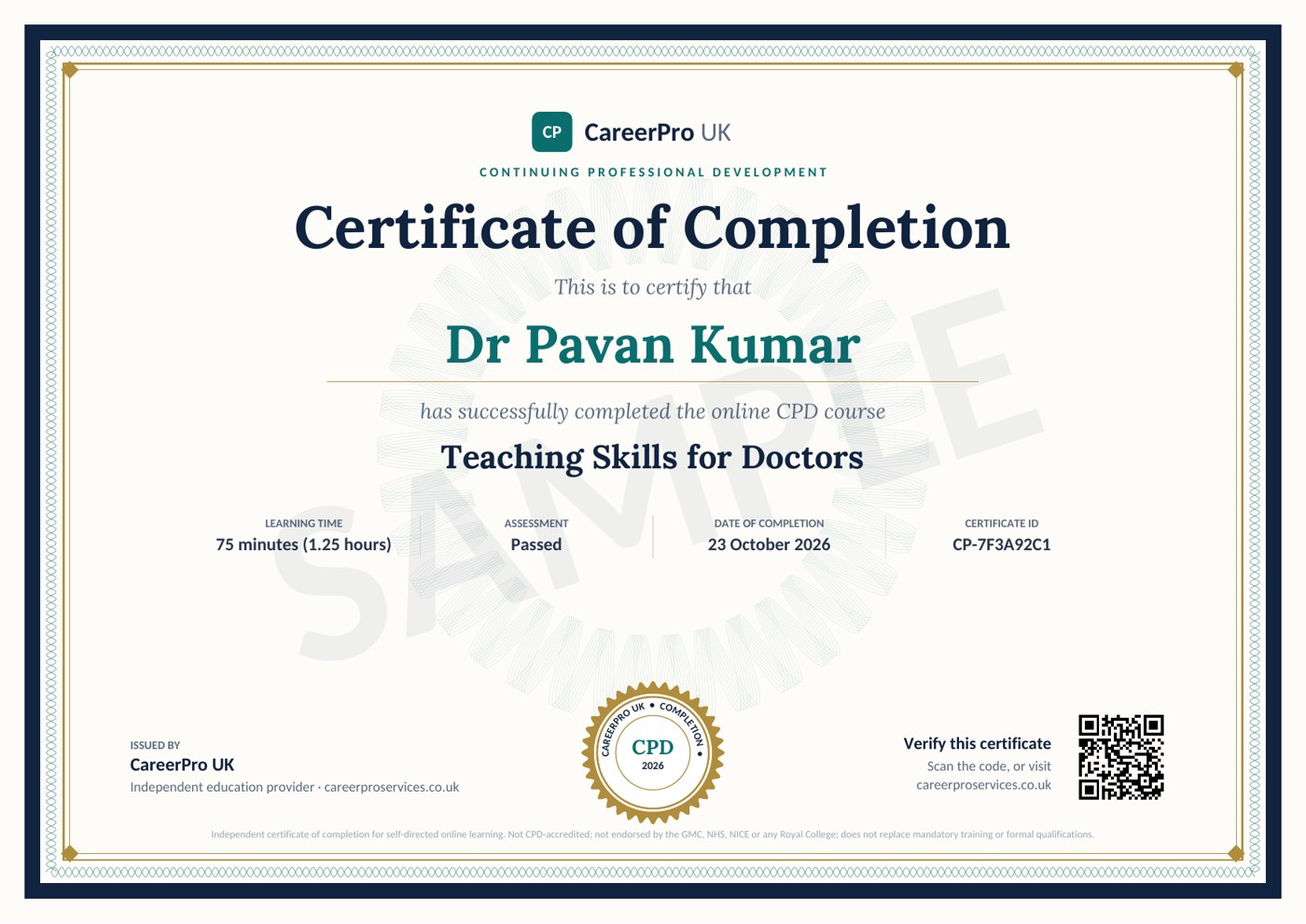
Finish with evidence you can show
Complete the course and pass the short quiz to earn a certificate of completion you can show to shortlisters, appraisers and interview panels.
- A verifiable certificate with a QR code — for your CV, portfolio and appraisal
- An appraisal-ready reflective note, pre-filled with the learning outcomes
- A ready-made CV line and a supporting-statement paragraph for NHS Jobs and Trac
- Add it to your LinkedIn profile in one click
- Pay £7 only at the end, and only if you pass — or save with a bundle
Communication is on every NHS person specification, is tested in almost every interview, and lies behind many complaints. This interactive course gives you NHS-style structure and words for the conversations doctors find hardest: breaking bad news with SPIKES, explaining risk and shared decisions, an angry relative, saying sorry and the duty of candour, DNACPR and treatment-escalation discussions, Martha's Rule, complaints and PALS, working with interpreters, and telephone and video consultations. You practise 'what would you say?' exercises and build a conversation plan you can download.
What you'll learn
- Structure a consultation and explore ideas, concerns and expectations
- Explain information clearly using chunk and check and teach-back, and communicate risk with natural frequencies
- Support shared decision-making in line with Montgomery and GMC consent guidance
- Break bad news using the SPIKES framework
- De-escalate an angry patient or relative and respond with empathy
- Apply the professional and statutory duty of candour, and apologise well
- Hold DNACPR and treatment-escalation conversations, and explain Martha's Rule
- Respond to complaints, work with interpreters and consult safely by phone and video
Course outline
1Foundations: consultations that work
- Welcome — why communication matters so much — Most complaints about doctors are not about clinical skills — they are about communication: not being listened to, not being told what was happening, or being spoken to without kindness.
- What the GMC and patients expect — The GMC's Good Medical Practice (2024) places communication at the heart of being a good doctor.
- Communication across cultures — what may feel different — Many international medical graduates trained in systems where doctors were more directive, families made decisions on behalf of patients, and bad news — especially a cancer diagnosis — was sometimes kept from the patient.
- A structure for every consultation — A structure stops you missing important parts of a consultation, especially when you are busy or the conversation is difficult. The Calgary–Cambridge guide, widely taught in UK medical schools, gives a simple structure:
- Ideas, concerns and expectations (ICE) — Patients do not arrive as blank slates. They come with their own ideas about what is wrong, worries about what it might mean, and hopes for what you will do.
- Listening and empathy — Listening sounds simple, but under pressure doctors often interrupt within moments of a patient starting to speak, jumping to closed questions to save time.
2Explaining, risk and shared decisions
- Explaining clearly — chunk, check and teach-back — Patients forget much of what doctors tell them, and often remember parts of it wrongly. Anxiety, unfamiliar words and too much information at once all make this worse.
- Communicating risk — Patients need to understand risk to make good decisions about treatment, but numbers are easy to misunderstand — for patients and for doctors. The way you present the same risk can make it sound frightening or trivial.
- Consent and shared decision-making — Since Montgomery v Lanarkshire Health Board (UK Supreme Court, 2015), doctors must tell patients about material risks — those a reasonable person in the patient's position would consider significant, or that this particular patient would consider significant — and about reasonable alternatives, including doing nothing.
3Breaking bad news
- Breaking bad news — SPIKES — Bad news is any information that seriously and negatively changes a person's view of their future: a cancer diagnosis, a stroke that will leave them disabled, a pregnancy loss, a death. How it is given stays with people for years.
- What to say — and what not to say — In difficult conversations, the exact words matter. Under stress, doctors tend to drift into medical language, fill silences with information, or offer reassurance they cannot back up — all from a wish to help.
- Practise — breaking bad news — Use SPIKES to plan the opening of this conversation. Write it as you would actually say it — real words, not a list of headings. Then compare with the model answer.
4When things go wrong: anger, apology and candour
- The angry patient or relative — Anger in hospital is usually fear or frustration in disguise: fear that a loved one is getting worse, frustration at waiting without information, or a feeling of being ignored.
- Saying sorry — and the duty of candour — Mistakes happen in every health system.
- DNACPR and treatment-escalation conversations — Decisions about CPR and treatment limits are among the most important conversations in hospital medicine — and frequently go wrong when patients or families are not involved.
- Martha's Rule — when families are worried — Martha's Rule was introduced by NHS England in 2024 after Martha Mills, 13, died of sepsis in hospital in 2021 when her family's concerns were not acted on.
5Complaints, interpreters and remote consultations
- Complaints and PALS — Almost every doctor will be named in a complaint at some point in their career. It is upsetting, especially at first, but it does not mean you are a bad doctor.
- Working with interpreters — Many patients in the NHS do not speak English as their first language, and some — including Deaf people who use British Sign Language — need an interpreter to communicate safely.
- Telephone and video consultations — Remote consultations are now a routine part of NHS care, from GP appointments to outpatient follow-up and giving results.
6Your evidence: interviews, role-plays and portfolio
- Communication in interviews and role-plays — Many NHS interviews — especially for specialty training and specialty doctor posts — include a communication scenario or role-play with an actor. Panels assess structure, empathy, honesty and safety.
- Plan your next difficult conversation — Think of a real difficult conversation you are likely to have soon — or one you could have done better. Build a plan below. It is saved on this device and you can download it.
- Evidence for your CV and portfolio — Communication is on almost every person specification, but it is hard to evidence with a certificate alone. Panels want to see that you have reflected on real conversations and improved.
- Using this course in your NHS application — Shortlisting for NHS posts is usually done by scoring your application against each criterion in the person specification, which are listed as essential or desirable.
- Summary
Frequently asked questions
Is the Communication Skills course free?
Yes. The Communication Skills course is free to study online after a quick free sign-up with your name and email. Studying is free. If you want a certificate of completion, it costs £7, and you pay only after you pass the quiz.
Who is this course for?
Foundation to intermediate — for doctors at every grade, especially international medical graduates. It is written for NHS doctors and international medical graduates (IMGs).
What will I learn?
You will be able to: structure a consultation and explore ideas, concerns and expectations; explain information clearly using chunk and check and teach-back, and communicate risk with natural frequencies; support shared decision-making in line with Montgomery and GMC consent guidance; break bad news using the SPIKES framework; de-escalate an angry patient or relative and respond with empathy; apply the professional and statutory duty of candour, and apologise well; hold DNACPR and treatment-escalation conversations, and explain Martha's Rule; respond to complaints, work with interpreters and consult safely by phone and video.
How long does it take?
The course has 6 short modules of about 15 minutes each, and your progress is saved so you can stop and come back. Your certificate records your learning time for your appraisal portfolio.
Is the course accredited?
Online course — does not replace face-to-face communication skills training. The certificate confirms completion of self-directed learning, which you can record in your appraisal portfolio with your own reflection.
Can I use it in my NHS job application?
Yes. List it under 'Courses and CPD' on your CV and in the education or training section of your NHS Jobs or Trac application, and use what you learned as evidence in your supporting statement. The certificate has a QR code so shortlisters can verify it.
✍️ Writing your NHS supporting statement? See an example paragraph for this criterion and examples for every other common person specification point.
Independent study guide by CareerPro UK, reviewed October 2026. About this course
This is an independent study guide to clinical communication, written in our own words from publicly available UK guidance (mainly GMC guidance on candour and consent, and NHS complaints arrangements) and widely taught communication models. It is not legal advice and does not replace your employer's policies on complaints, candour and incident reporting. Arrangements differ in Scotland, Wales and Northern Ireland.
CareerPro UK is an independent education provider. Our courses are not produced, endorsed, approved or accredited by the General Medical Council (GMC), the NHS, NICE, any Royal College or any other official body, and we are not affiliated with them. Courses are study guides written in our own words from publicly available guidance. They do not replace the official guidance, which can change — always check the current version (e.g. at gmc-uk.org and nice.org.uk). They are not legal or professional advice: for a specific situation, follow your employer's policies and speak to your seniors or your medical defence organisation.
Quiz
Answer all 15 questions. You need 12 correct to pass. You can retake it.
Get your certificate
Your certificate is ready
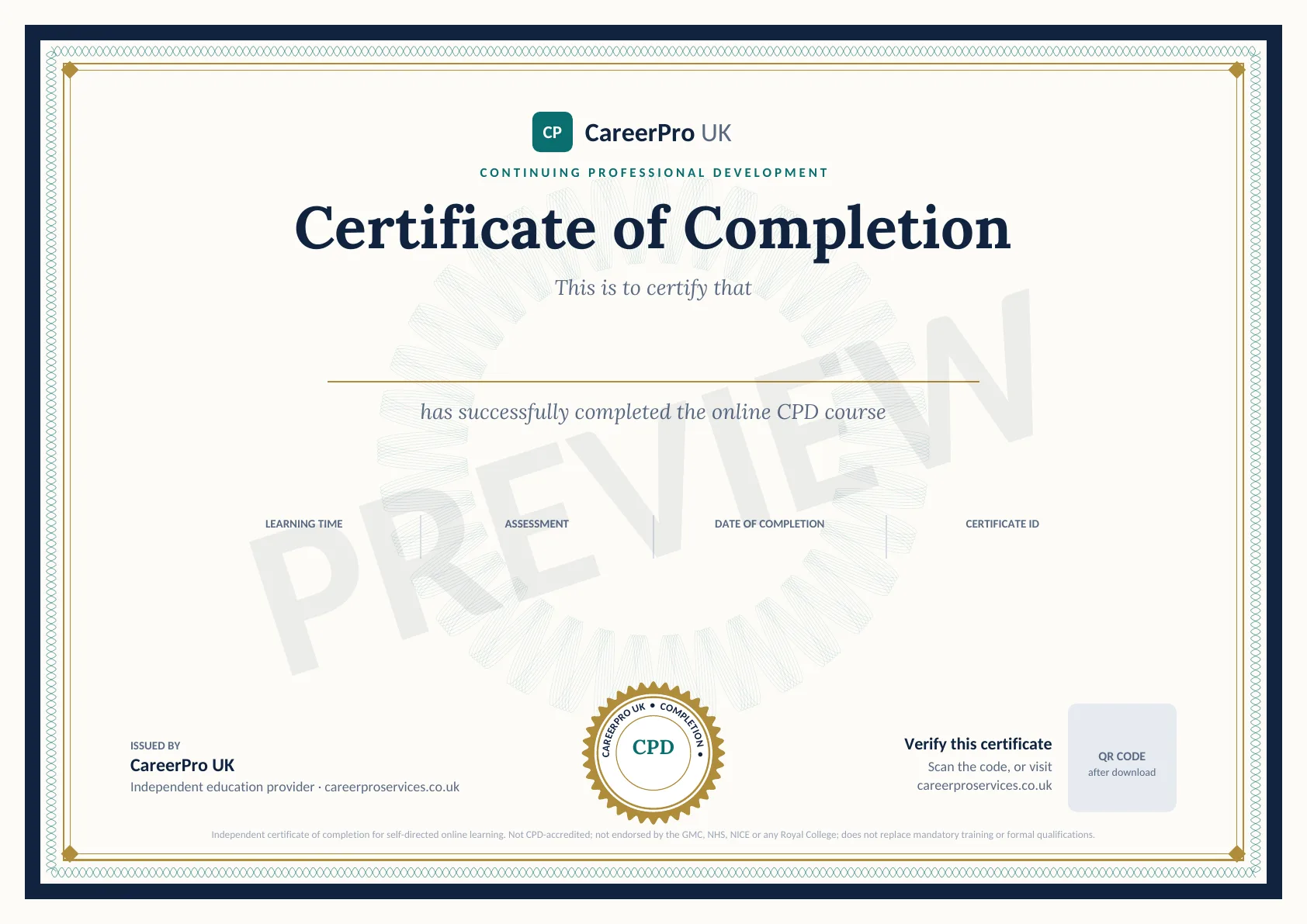
- Your verifiable PDF certificate with a QR code, so shortlisters and appraisers can check it's genuine
- A ready-to-paste line for your NHS Jobs or Trac application and your CV
- An appraisal-ready reflective note, pre-filled with the course's learning outcomes and your CPD time
- One-click add to your LinkedIn profile
The course itself is free. The certificate pack is a one-off £7, with no subscription. Payment is handled securely by Stripe, and we never see your card details.
Have a bundle code?
Taking several courses? Save with a certificate bundle — from £27 for 6 certificates.
Well done — you've passed
Keep the PDF — its QR code lets an appraiser or employer confirm it's genuine.
Independent certificate of completion; not CPD-accredited or endorsed by the GMC, NHS or any Royal College.
Write a quick reflection for your portfolio
Appraisers value reflection more than certificates. Jot down a few lines while it's fresh — it stays on this device until you copy it.
Free sign-up to start this course
Sign up once with your email and you can study every course free. Your certificate is optional and paid only after you pass.
We use your details to give you access to the courses. See our privacy notice.
Get new courses and NHS job alerts
Optional — leave your email if you'd like us to tell you about new CPD courses, NHS job alerts and career support. You can unsubscribe at any time.
See our privacy notice.